Intuition
A sequence of functions can converge in the simplest way imaginable: fix a point, and the numbers at that point converge. Nothing else is asked, and nothing else is delivered. The limit function is perfectly well defined and almost every good property of the functions can fail to reach it — continuity, the value of the integral, the derivative. This lesson is the list of failures, and the next one is the condition that prevents them.
A committee where every member eventually settles on an opinion. The committee as a whole need not settle at any particular moment, because different members settle at different times. Asking each member separately is a much weaker question than asking the committee to have finished.
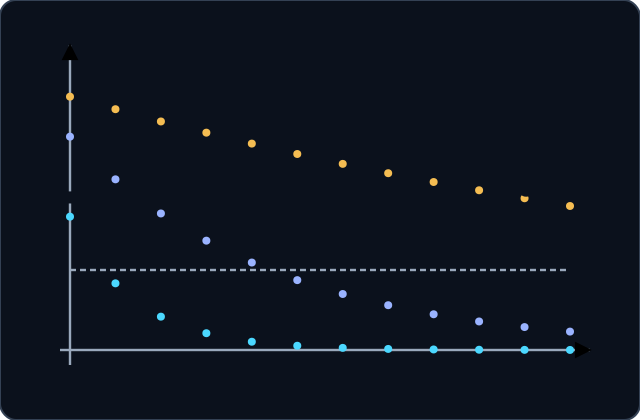
Each row is one fixed point: the values at , and , against . Every row falls to zero, and the nearer the point is to the later it arrives: the terms are within of the limit from at , from at , and only from at . No single stage serves every point of at once.
The definition, and its four failures
A sequence of functions on a set converges pointwise to when for every . Written out: for every and every there is an , which may depend on both, with for . The place is chosen after the point, which is the whole of what goes wrong.
What pointwise convergence does not keep
- Continuity: on is continuous for every and its pointwise limit jumps at .
- The value of the integral: a tall thin spike of area that moves towards the origin converges pointwise to , and its integral stays .
A limit of continuous functions need not be continuous
Compute the limit at each point separately, which is all pointwise convergence asks. At a point strictly between zero and one the powers shrink to nothing, because a number below one in size has powers tending to zero. At the right endpoint every function takes the value one, so the limit there is one. The limit function therefore jumps, although every function in the sequence is a polynomial.
Proof steps
A number below one in size has powers tending to zero, proved in chapter five.
At the right endpoint every term of the sequence is one.
So the pointwise limit is a step.
Every function in the sequence is a polynomial and the limit is discontinuous.
Applications
Practice
One Point at a Time
Pointwise convergence is the convergence of the numbers at each fixed point, and nothing more.
Try it
What does pointwise on mean?
Try it
on . What is the limit at ?
Try it
on . What is the pointwise limit?
Try it
A pointwise limit of continuous functions is continuous.
The Moving Spike
A bump whose area stays fixed while it grows taller, thinner and closer to the origin leaves nothing behind at any point.
Try it
is a triangular spike of height and base width near the origin, zero elsewhere on . What happens?
Try it
If pointwise and every is differentiable, then .
Try it
A triangular spike of height and base width has what area?
What You Learned
- Pointwise convergence asks a question at each point separately.
- It does not keep continuity, the value of an integral, or a derivative.
- The place may depend on the point, and usually must.
- Every failure comes from that dependence.
Final checkpoint
Try it
Why does pointwise convergence keep so little?
Try it
A pointwise limit function always exists when each sequence of values converges.
Completion
Lesson complete
Great work! You now know how to:
- State pointwise convergence and read its quantifiers
- Give the standard failures of continuity, integration and differentiation
- Compute a pointwise limit function
- Say why the dependence of the place on the point is the cause