Intuition
The second repair. Under uniform convergence the integral of the limit is the limit of the integrals, and the proof is one line of estimate: the two integrals differ by at most the worst error times the length of the interval. Under pointwise convergence the statement is false, and the moving spike of the first lesson is the counterexample — its integral is one at every stage and zero in the limit.
If every reading of a meter is within a hundredth of the true value, the total over an hour is within a hundredth of an hour’s worth of the true total. If instead each reading is eventually accurate but the moment differs from second to second, the total can be anything.
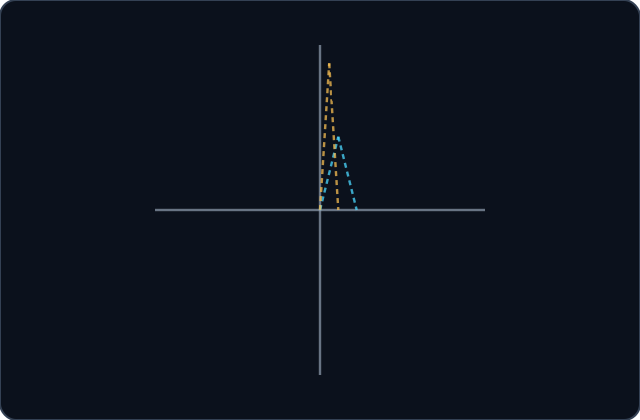
Two stages of the moving spike: height over the base , so the area is at every stage. It grows taller and thinner as it crowds towards the origin; every fixed lies outside it once , and throughout. The pointwise limit is the zero function, whose integral is .
The theorem and its counterexample
If each is integrable on and uniformly there, then is integrable and . The estimate is , where is the worst error. Under pointwise convergence alone both conclusions can fail: the limit may not be integrable, and the integrals may converge to the wrong number.
What each hypothesis does
- The interval must be bounded: the estimate is the worst error times its length, and on an unbounded interval that is useless.
- Integrability of the limit is part of the conclusion and needs proof, by the criterion applied to a function of the sequence close enough to it.
- Pointwise convergence gives neither half: the moving spike has integrals equal to and a limit with integral .
- For series the statement reads under uniform convergence of the partial sums, which is where the next lesson but one applies it.
Uniform convergence lets the integral through
Estimate the difference of the integrals by the integral of the difference, which the order property of chapter eight supplies. The integrand is then bounded everywhere by the worst error, which is a single number not depending on the point, so the estimate for an integral by a bound on its integrand applies and gives the worst error times the length. Since the worst error tends to zero and the length is fixed, the difference of the integrals does too.
Proof steps
Additivity in the integrand.
The absolute value estimate of chapter eight.
Uniformity: one bound serving every point.
A bound on the integrand times the length of the interval.
The length is fixed and the worst error vanishes.
Applications
Practice
One Bound, Times the Length
Uniformity turns a bound on the functions into a bound on the integrals.
Try it
and the interval is . What bounds ?
Try it
The moving spike has and pointwise. What does that show?
Try it
The theorem holds on an interval of any length.
Try it
uniformly on with . What is ?
Try it
Which step of the proof uses uniformity?
Try it
Under uniform convergence the integrability of the limit has to be proved and is not assumed.
Try it
On , how small must the worst error be to guarantee the integrals differ by at most ?
What You Learned
- Uniform convergence lets the integral through, with error at most the worst error times the length.
- Integrability of the limit is part of the conclusion.
- Pointwise convergence gives neither half, and the moving spike shows it.
- The interval must be bounded.
Final checkpoint
Try it
Which hypothesis is missing if although pointwise on ?
Try it
A uniformly convergent series of integrable functions may be integrated term by term.
Completion
Lesson complete
Great work! You now know how to:
- State the theorem and its estimate
- Say where uniformity is used and why pointwise fails
- Bound the error in an integrated approximation
- Integrate a uniformly convergent series term by term