Intuition
The fifth chapter stated that the series of reciprocal powers converges exactly when the exponent exceeds one, proved the case of exponent one by grouping, and left the rest. The debt is paid here. A decreasing positive function and the series of its values at the whole numbers bound each other by their bars against its area, so the series and the integral converge or diverge together.
A staircase drawn against a ramp. Each step of the staircase overhangs the ramp on one side and is overhung on the other, so the total height of the steps and the area under the ramp are each within one step of the other. If one is finite so is the other.
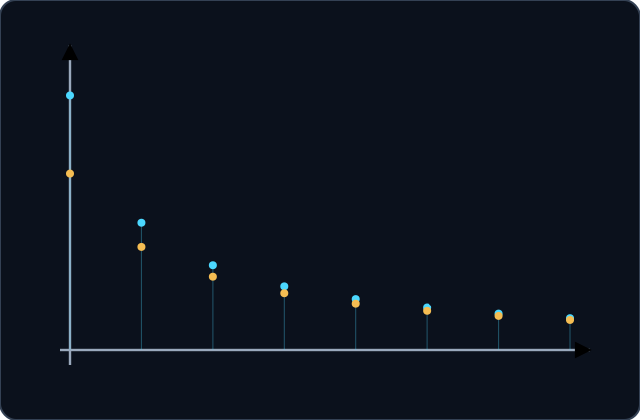
The bars are the terms and the lower row is the area of the strip under over each unit stretch. Each bar is at least its strip and at most the previous one, so the two totals differ by at most the first term.
The test, and the debt it pays
Let be positive and decreasing on and put . Then converges if and only if the integrals stay bounded as grows. The comparison is bar by bar: , because decreases and each strip has width one.
What it settles
- converges exactly when : the integral of over stays bounded exactly then. This closes the debt recorded in the fifth chapter.
The integral test
Compare one bar with one strip. On the stretch from a whole number to the next, the function is between its values at the two ends because it decreases, so the strip of area under it is between those two values times the unit width. Adding these over the stretches gives the partial sums of the series on either side of the integral. Both the partial sums and the integrals increase, because the function is positive, so each is bounded exactly when the other is, and bounded increasing means convergent.
Proof steps
The function decreases, so on a stretch of width one the area is between the two end values.
Add these over the stretches; the two sides are partial sums shifted by one.
The function is positive, so nothing ever decreases.
Each is squeezed by the other, so one is bounded exactly when the other is.
An increasing sequence converges exactly when it is bounded.
Applications
Practice
Positive and Decreasing
Only then is a bar squeezed between the two strips beside it.
Try it
What does the integral test require of the function?
Try it
For which does converge?
Try it
The integral test gives the sum of a convergent series.
Try it
Does converge?
Try it
For , the tail after terms is at most . What is that for ?
Try it
The integral test is a comparison test with an integral in place of a second series.
Try it
What is ?
What You Learned
- A positive decreasing function has its series and its integrals converging together.
- converges exactly when , which closes the debt from chapter five.
- The test decides convergence and estimates the tail.
- It is comparison, with an integral chosen because it can be evaluated.
Final checkpoint
Try it
Which series does the integral test settle that the comparison tests of chapter five do not?
Try it
The condition for was proved in this course before this lesson.
Completion
Lesson complete
Great work! You now know how to:
- State the integral test with both of its hypotheses
- Settle the convergence of for every
- Estimate the tail of a convergent series by an integral
- Say why the test is a comparison in disguise