Intuition
To measure the area under a graph, cut the interval into pieces and on each piece take a rectangle that is certainly too tall and one that is certainly too short. Adding them gives a number above the answer and a number below it. Refining the cut can only lower the first and raise the second, so the two families of numbers press towards each other — and whether they meet is the question the whole chapter is about.
A field of irregular shape is measured by covering it with square tiles: count the tiles that overlap it at all, and the tiles entirely inside. The first count is too many and the second too few, and using smaller tiles narrows the gap. The area is what the two counts agree on, if they ever do.
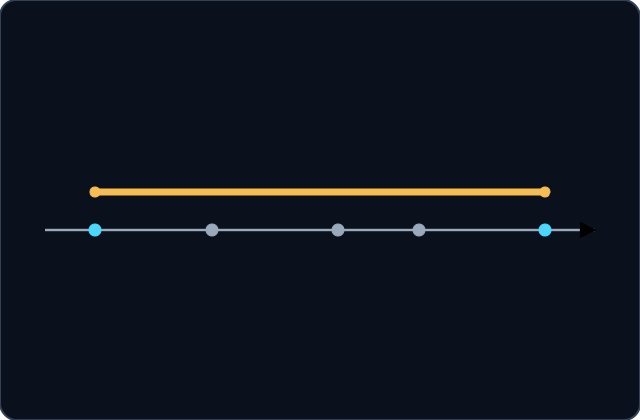
A partition of is a finite list of points starting at and ending at . The pieces need not have equal widths, and nothing in the definition asks them to.
The definitions
A partition of is a finite set . For a bounded put and . The upper sum is and the lower sum , where . Boundedness is needed for the suprema and infima to exist, and it is assumed from here on.
How the sums move
- for every partition, since on each piece.
Refining narrows the gap
It is enough to add one point, since a refinement is reached by adding points one at a time. Adding a point splits one piece into two. The supremum over each half is at most the supremum over the whole, because the half is a subset, so the two new rectangles together are no taller than the old one over the same total width. The upper sum therefore does not rise; the argument for infima is the mirror image, and the middle inequality is the one already known.
Proof steps
It is enough to add a single point, and repeat.
A supremum over a subset is at most the supremum over the whole piece.
The two new widths add to the old one.
So the two new rectangles contribute at most what the old one did, and nothing else changes.
The mirror argument with infima, which are at least the old infimum on each half.
Applications
Practice
A Finite Cut, Not Necessarily Equal
A partition is a finite increasing list from one endpoint to the other. Equal widths are a convenience and never a requirement.
Try it
Which is a partition of ?
Try it
on with the partition . What is ?
Try it
For the same on and partition , what is ?
Try it
Refining a partition can raise the upper sum.
Every Lower Sum Is Below Every Upper Sum
Two unrelated partitions are compared through the partition containing both.
Try it
Why is for any two partitions?
Try it
The definitions of the upper and lower sums need to be bounded.
Try it
Must the pieces of a partition have equal widths?
Try it
on refined to . What is now?
What You Learned
- A partition is a finite increasing list from one endpoint to the other.
- Upper and lower sums use the supremum and infimum on each piece.
- Refining lowers the upper sum and raises the lower sum.
- Every lower sum is below every upper sum, by the common refinement.
Final checkpoint
Try it
Some lower sum of a bounded function can exceed some upper sum of the same function.
Try it
A point is added to a partition. What happens to the two sums?
Completion
Lesson complete
Great work! You now know how to:
- Write down a partition and compute an upper and a lower sum
- Say which way each sum moves under refinement
- Prove that every lower sum is below every upper sum
- Say why boundedness is assumed throughout