Intuition
Fix the left endpoint and let the right one move: the integral becomes a function of where you stop. That accumulating function is always continuous, whatever the integrand does, and wherever the integrand is continuous the accumulating function is differentiable with the integrand as its derivative. So integration undoes differentiation, and every continuous function has an antiderivative — which is not obvious and is the first half of the Fundamental Theorem.
A water meter records the total that has passed. The reading changes smoothly even when the flow is turned on and off abruptly, and wherever the flow is steady the rate at which the reading climbs is exactly the flow at that moment.
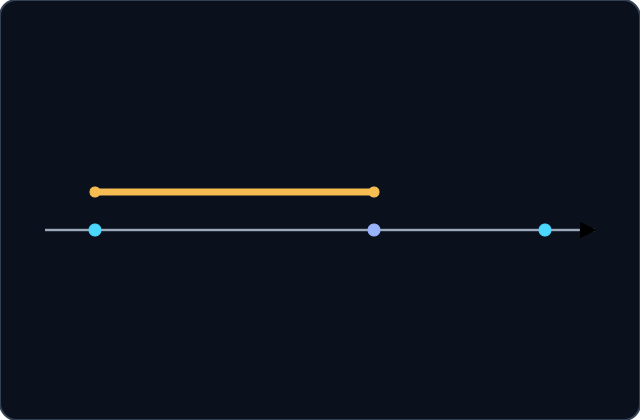
is the total accumulated up to the moving endpoint. Moving a little changes by the integral over a short stretch, which is small — and, where is continuous, is almost times the step.
The accumulating function
Let be integrable on and put for . Then is continuous on ; indeed it is Lipschitz, with constant any bound for . If is continuous at a point , then is differentiable there with . In particular, every continuous function on a closed bounded interval has an antiderivative.
What is needed where
- Continuity of needs only integrability of : where bounds .
The accumulating function differentiates back
Estimate the difference quotient directly. The change in the accumulating function over a short step is the integral of the integrand over that step, by additivity. Subtracting the constant value at the point, written as an integral of a constant over the same step, turns the quotient into an average of the amount by which the integrand differs from that value. Continuity makes that difference small throughout a short enough step, and the estimate for an integral by a bound on the integrand finishes it.
Proof steps
Additivity of the integral in the interval.
The constant is written as an integral of itself over the same stretch.
Continuity at the point supplies a radius.
The estimate for an integral by a bound on the integrand.
The quotient is within the tolerance of the value for every small enough step.
Applications
Practice
Integration Undoes Differentiation
The accumulating function has the integrand as its derivative, wherever the integrand is continuous.
Try it
is continuous on and . What is ?
Try it
is continuous whenever is integrable, even if has jumps.
Try it
has a jump at and is continuous elsewhere on . Where is differentiable?
Try it
. What is ?
A Moving Upper Limit
When the upper limit is itself a function, the chain rule applies to the composition.
Try it
What is , for a continuous ?
Try it
Every continuous function on a closed bounded interval has an antiderivative there.
Try it
on and . What is the largest possible value of ?
What You Learned
- The accumulating function is continuous whenever the integrand is integrable.
- It is differentiable wherever the integrand is continuous, with the integrand as its derivative.
- So every continuous function has an antiderivative.
- A moving upper limit brings the chain rule with it.
Final checkpoint
Try it
What is needed for to be differentiable at with ?
Try it
Integration can turn a discontinuous function into a continuous one.
Completion
Lesson complete
Great work! You now know how to:
- Say what the accumulating function is and why it is continuous
- Differentiate an accumulating function, including one with a moving upper limit
- Say what the theorem needs at the point and what it needs globally
- Conclude that every continuous function has an antiderivative