Intuition
Comparing two suprema taken over all partitions is a clumsy way to decide integrability. The criterion replaces it by something a proof can actually use: the function is integrable exactly when some partition makes the gap between its upper and lower sums smaller than any given tolerance. One partition per tolerance, which is the same shape as every other definition in this course.
Instead of asking whether the highest bid ever meets the lowest asking price, ask whether a single pair of bids can be found within a penny of each other. If that can be done for every tolerance the two must meet, and the question has become one anybody can answer by producing a pair.
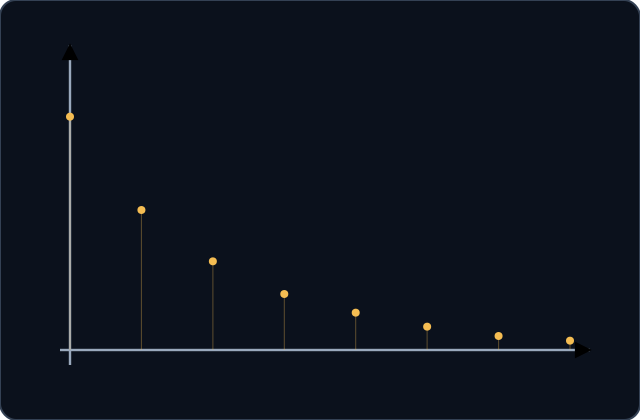
The total gap as the partition is refined. The criterion asks that this fall below any tolerance for some partition — not that it fall to zero along any particular sequence of partitions.
The condition a proof can use
A bounded on is integrable if and only if for every there is a partition with . The difference can be written , and is the oscillation of on the th piece. So the criterion says: the oscillation, weighted by the widths, can be made as small as one likes.
Reading the criterion
- One partition per tolerance is enough. There is no need to say anything about all partitions.
- The oscillation is what must be made small, and there are two ways: small on every piece, or large on pieces whose total width is small.
- A continuous function takes the first route, using uniform continuity; a monotone function takes a version of the second, with the oscillations telescoping.
- Once a partition works for a tolerance, every refinement of it works too, since refining only narrows the gap.
- The criterion also gives the value: the integral lies between and , so either is within the tolerance of it.
The Riemann criterion
Both directions are squeezes. If such a partition exists for every tolerance, then the gap between the upper and lower integrals is below every tolerance, since those two numbers lie between the lower and upper sums of that partition; a non-negative number below every positive number is zero. Conversely, if the two integrals agree, the definitions of the infimum and the supremum supply a partition whose upper sum is within half the tolerance above and another whose lower sum is within half below, and their common refinement does both at once.
Proof steps
Suppose the condition holds and take such a partition.
Both integrals lie between the two sums of any partition.
A non-negative number below every tolerance is zero.
The upper integral is an infimum, so some partition comes within half the tolerance.
And the lower integral is a supremum, so some partition comes within half from below.
The common refinement inherits both, because refining narrows the gap.
Applications
Practice
One Partition Per Tolerance
The criterion asks for a witness, not a statement about every partition.
Try it
What does the Riemann criterion ask you to produce?
Try it
What does equal?
Try it
A partition of into two equal pieces has oscillations and . What is ?
Try it
A partition that satisfies the criterion for a tolerance stays satisfactory after refinement.
Two Ways to Make the Total Small
Either every oscillation is small, or the large ones sit on pieces of tiny total width.
Try it
A function has one jump inside and is continuous elsewhere. How is the criterion satisfied?
Try it
To apply the criterion you must consider every partition.
Try it
on with equal pieces. The gap equals what, for ?
What You Learned
- Integrability is equivalent to a partition per tolerance with a small gap.
- The gap is the sum of the oscillations weighted by the widths.
- Small oscillation everywhere, or large oscillation on a small total width, both work.
- Refining a working partition keeps it working.
Final checkpoint
Try it
Which condition is equivalent to integrability?
Try it
A partition satisfying the criterion also gives an estimate of the integral.
Completion
Lesson complete
Great work! You now know how to:
- State the Riemann criterion with its quantifiers in order
- Write the gap as a weighted sum of oscillations
- Name the two ways of making that sum small
- Read an estimate of the integral off a working partition