Intuition
Upper and lower sums are built from suprema and infima, which are convenient for proofs and impossible to compute. A Riemann sum instead evaluates the function at one chosen point of each piece — any point at all — and weights it by the width. For an integrable function these sums converge to the integral as the partition gets fine, whatever points are chosen, which is what makes numerical integration possible and what most calculus courses take as the definition.
Rather than finding the tallest and the shortest blade of grass in each square metre, measure one blade per square metre, chosen however you like. If the field is well behaved the estimate is good, and it improves as the squares shrink, however unlucky the choices.
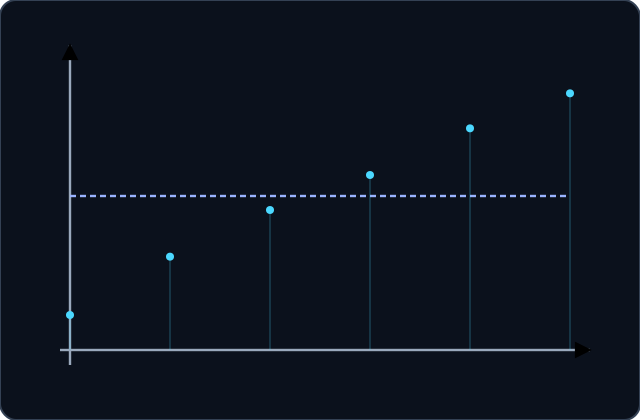
One value is taken from each piece and multiplied by the width of that piece. The level drawn across is the average the total represents; as the pieces narrow, the choice inside each matters less and less.
Tagged partitions and the mesh
A tagged partition is a partition together with a chosen point for each piece, and its Riemann sum is . The mesh of is the largest of the widths. For an integrable , the Riemann sums converge to as the mesh tends to zero, whatever tags are chosen. Every Riemann sum lies between the lower and upper sums of its partition.
What the tags can and cannot do
- for every choice of tags, since each chosen value lies between the infimum and the supremum on its piece.
- So a partition satisfying the criterion pins every Riemann sum to within the tolerance of the integral, whatever the tags.
Riemann sums are trapped
Compare the sums piece by piece. On each piece the chosen value lies between the infimum and the supremum, simply because those are the greatest lower bound and least upper bound of the values there. Multiplying by a positive width preserves both inequalities, and adding over the pieces preserves them again. The conclusion is that the tags cannot escape the bracket the partition already provides.
Proof steps
The chosen point lies in the piece, so its value lies between the two extremes there.
Multiply by the width, which is positive.
Add over the pieces; inequalities survive addition.
Both the sum and the integral lie in the same bracket, so they are within its width of each other.
Applications
Practice
One Point Per Piece, Chosen Freely
A tag is any point of its piece. The theory does not care which.
Try it
Which points may be used as tags?
Try it
on with pieces and and right-endpoint tags. What is the Riemann sum?
Try it
A Riemann sum can be larger than the upper sum of its own partition.
Try it
What is the mesh of a partition?
Endpoints for a Monotone Function
For an increasing function the extremes on each piece sit at its two ends.
Try it
is increasing. Which Riemann sum equals the lower sum?
Try it
on with two equal pieces and midpoint tags. What is the Riemann sum?
Try it
For an integrable function the limit of the Riemann sums depends on how the tags are chosen.
What You Learned
- A tagged partition chooses one point per piece, freely.
- Every Riemann sum lies between the lower and upper sums of its partition.
- For an integrable function the limit is the integral, whatever the tags.
- Endpoint rules reproduce the upper and lower sums for a monotone function.
Final checkpoint
Try it
Why is the theory built on upper and lower sums rather than on Riemann sums?
Try it
Defining the integral as a limit of Riemann sums gives a different class of integrable functions.
Completion
Lesson complete
Great work! You now know how to:
- Compute a Riemann sum with given tags
- Say why every Riemann sum is trapped by its partition
- Name the mesh and say what it controls
- Say why the theory is built on upper and lower sums