Intuition
Everything a derivative tells you about a function on an interval comes from this one theorem. A zero derivative means constant; a positive derivative means increasing; two functions with the same derivative differ by a constant; and a bounded derivative bounds how fast the values can move. None of these is obvious from the definition, because the definition is about one point at a time, and all of them are about a whole interval.
A speedometer reading is local and a journey is not. Knowing the speed was zero at every instant tells you the car did not move only because every stretch of the journey had some instant whose speed was its average — which is precisely what the theorem supplies.
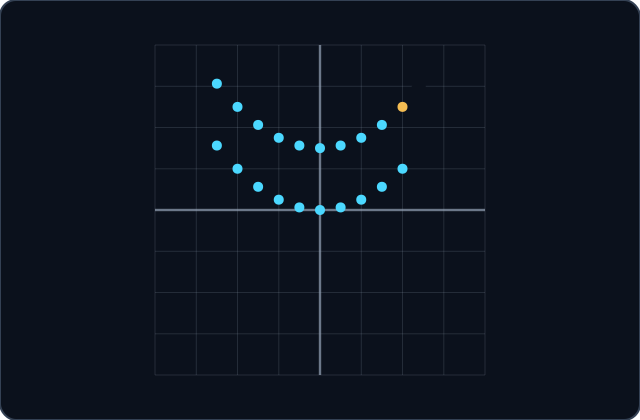
Two functions with the same derivative everywhere. The gap between them never changes, and the theorem applied to their difference is what proves it — a fact the definition of a derivative, which sees one point at a time, cannot give.
Four consequences, all one proof
Let be differentiable on an interval . If throughout then is constant. If throughout then is strictly increasing, and gives increasing in the weak sense. If throughout then is constant. And if then . Each is the Mean Value Theorem applied on the interval between two points.
The conditions and the converses
- The domain must be an interval: on the function equal to for positive inputs and for negative ones has zero derivative and is not constant.
- gives strictly increasing; the converse fails, since is strictly increasing with .
A zero derivative means constant
Take any two points of the interval and apply the Mean Value Theorem between them. Because the domain is an interval, the whole stretch between the two points lies inside it, so the hypotheses hold there. The theorem supplies a point at which the derivative equals the average rate; the derivative is zero everywhere, so the average rate is zero, so the two values are equal. The points were arbitrary, so no two values differ.
Proof steps
Take two arbitrary points of the interval.
The domain is an interval, so everything between them belongs to it as well.
Apply the Mean Value Theorem on that stretch.
The derivative vanishes everywhere, so the right-hand side is zero.
The two points were arbitrary, so no two values differ.
Applications
Practice
Local Information, Global Conclusion
The theorem is what turns a statement at every point into a statement about the whole interval.
Try it
for every in an interval. What follows?
Try it
A function with zero derivative on its whole domain is constant.
Try it
for every in an interval. What follows?
Try it
A strictly increasing differentiable function has everywhere.
Try it
on an interval containing and . What is the largest possible value of ?
Same Rate, Fixed Gap
Apply the constant result to the difference of the two functions.
Try it
throughout an interval. What follows?
Try it
is positive to the left of and negative to the right, and is continuous at . What is at ?
What You Learned
- A zero derivative on an interval means constant, and the domain being an interval is essential.
- A positive derivative means strictly increasing; the converse is only the weak statement.
- Equal derivatives on an interval mean the functions differ by a constant.
- A bounded derivative gives the Lipschitz bound, and hence uniform continuity.
Final checkpoint
Try it
A differentiable function with bounded derivative on an interval is uniformly continuous there.
Try it
and are differentiable on with and . What follows?
Completion
Lesson complete
Great work! You now know how to:
- Derive the constant, monotonicity and Lipschitz results from one theorem
- Say why the domain must be an interval
- State the correct converse of the monotonicity result
- Use the first derivative test to locate a local extreme value