Intuition
The tangent line is the best linear approximation to a function at a point, and its error vanishes faster than the step. Using more derivatives gives a polynomial whose error vanishes faster still, and the theorem says exactly how much faster: the error is the next term of the same shape, with the derivative evaluated at an unknown point inside the interval. It is the Mean Value Theorem with more derivatives, and its proof is Rolle applied to a cleverly chosen function.
A ship’s position is predicted from its current position, then corrected by its velocity, then by its acceleration, and so on. Each correction improves the prediction over a short interval, and the theorem quantifies what is left over after any number of corrections — in terms of one more derivative, measured at a time nobody knows.
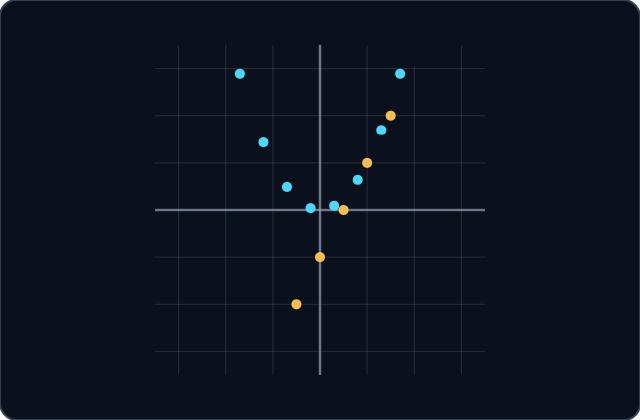
The curve is and the straight run of dots is its tangent at . Near the point of contact the two are indistinguishable; the gap between them grows like the square of the step, which is exactly what the remainder term says.
The polynomial, and the size of what is left
Suppose has derivatives on an interval containing and . The Taylor polynomial of degree at is , and Taylor's theorem with the Lagrange remainder says for some strictly between and . The case is the Mean Value Theorem.
What it says and what it does not
- agrees with in value and in the first derivatives at , and it is the only polynomial of its degree that does.
- The point is unknown and depends on and on ; the theorem is used by bounding over the interval rather than by finding it.
Taylor's theorem with the Lagrange remainder
Fix the point at which the value is wanted and choose a number making an auxiliary function vanish there. That auxiliary function is the difference between the function and its Taylor polynomial, less a multiple of the highest power; by construction it vanishes at the base point together with its first n derivatives, and the number was chosen so that it vanishes at the other point too. Rolle then applies, and applying it repeatedly — each time to the derivative of the last — walks the vanishing point up until the highest derivative is reached, which identifies the number.
Proof steps
Define the number by demanding that the formula hold at the point in question.
Form the auxiliary function of a new variable.
It vanishes at the base point to order n, because the polynomial was built to match, and at the other point by the choice of M.
Each application produces a zero of the next derivative, strictly inside the previous interval.
The polynomial has vanished by then, and the highest power contributes the factorial.
Applications
Practice
The Error Is One More Term
The remainder has the shape of the next term, with the derivative read at an unknown interior point.
Try it
Where is the derivative in the remainder evaluated?
Try it
What does Taylor's theorem say when ?
Try it
on . Using the tangent line at , what is the largest possible error at ?
Try it
As the degree grows, the Taylor remainder always tends to zero.
Try it
What does share with at the base point?
Try it
The proof of Taylor's theorem applies Rolle's theorem repeatedly.
Try it
and . What is the coefficient of in the Taylor polynomial?
What You Learned
- matches the value and the first derivatives at the base point.
- The remainder has the shape of the next term with the derivative read at an unknown interior point.
- is the Mean Value Theorem.
- The theorem bounds an error; it says nothing about convergence as the degree grows.
Final checkpoint
Try it
How is Taylor's theorem used in practice?
Try it
The tangent line at a point is the Taylor polynomial of degree one there.
Completion
Lesson complete
Great work! You now know how to:
- Write the Taylor polynomial and say what it matches
- State the Lagrange remainder and say where its derivative is read
- Bound an approximation error by bounding a derivative
- Say what the theorem does not claim about growing degree