Intuition
At an interior point where a differentiable function is largest, the derivative must be zero: a non-zero rate would let the values be increased by stepping one way or the other. That one observation, combined with the Extreme Value Theorem, gives the first of the two great theorems of this chapter: a differentiable function with equal values at the two ends of an interval is flat somewhere inside.
A walk that starts and finishes at the same altitude must have had a moment of level ground, at the highest or the lowest point reached. If neither extreme is at an end of the walk, it is reached somewhere in the middle, and there the ground cannot be sloping.
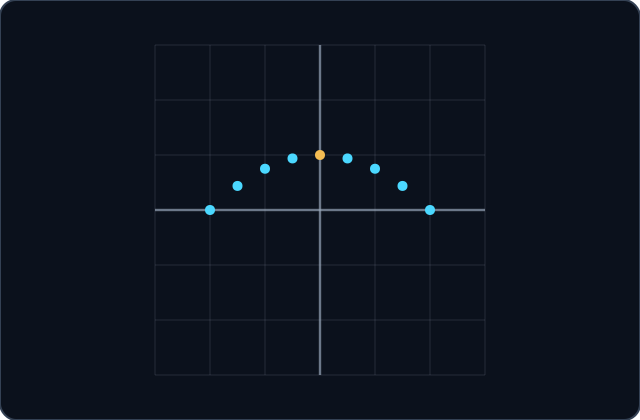
The dots trace a differentiable function with the same value at both ends. Its largest value is reached inside the interval, and there the derivative is zero — a non-zero rate would let the value be raised by stepping one way.
Two statements, the second from the first
Interior extremum: if has a largest or smallest value on an interval at an interior point and exists, then . Rolle: if is continuous on , differentiable on and , then for some . The second follows from the first together with the Extreme Value Theorem.
Hypotheses, and what fails without each
- The point must be interior. on has its largest value at an endpoint and derivative there.
- The derivative must exist. on has a smallest value at and no derivative there.
Rolle's theorem
The Extreme Value Theorem applies, because the function is continuous on a closed bounded interval, so it attains a largest and a smallest value. If both are attained only at the endpoints then, since the two end values agree, the largest and smallest values are equal and the function is constant, whose derivative vanishes everywhere. Otherwise one of the two extremes is attained at an interior point, and the interior extremum result makes the derivative zero there.
Proof steps
The Extreme Value Theorem applies to a continuous function on a closed bounded interval.
The two end values agree, so if both extremes live there the function never moves.
A constant function has derivative zero everywhere, so the conclusion holds and more.
The remaining case: one of the two extremes is reached strictly inside.
The interior extremum result applies, since the derivative exists there.
Applications
Practice
A Non-Zero Rate Means Room to Move
At an interior largest value a non-zero derivative would let the value be increased on one side.
Try it
has its largest value on at an interior point and exists. What follows?
Try it
Why must the extreme point be interior?
Try it
A continuous function with equal values at the two ends of an interval has a point inside where its derivative is zero.
Try it
on has . At which point is ?
Try it
Rolle asks for continuity on which interval and differentiability on which?
Try it
Between two roots of a differentiable function there is a root of its derivative.
Try it
A differentiable function has a derivative with exactly one root. At most how many roots can the function have?
What You Learned
- At an interior extreme point a derivative that exists must be zero.
- Rolle follows from that together with the Extreme Value Theorem.
- Continuity is needed on the closed interval and differentiability only on the open one.
- Between two roots of a function there is a root of its derivative.
Final checkpoint
Try it
Rolle's theorem identifies the point at which the derivative vanishes.
Try it
on has and no point where . Which hypothesis fails?
Completion
Lesson complete
Great work! You now know how to:
- Prove that an interior extreme point has zero derivative
- Derive Rolle's theorem from that and the Extreme Value Theorem
- Say which hypothesis each standard counterexample breaks
- Count roots of a function from roots of its derivative