Intuition
The average rate of change of a function over a stretch is the quotient of the change in the values by the change in the inputs. Shrink the stretch and ask for the limit: if it exists, it is the derivative. The quotient is undefined at the point itself, which is the whole reason the last chapter insisted that a limit never looks at the value at the point.
A speedometer reads a speed at an instant, which is not an average over any stretch of time. What it reports is the number the averages over shorter and shorter stretches converge on — and each of those averages is computed over an interval that never shrinks to nothing until the limit is taken.
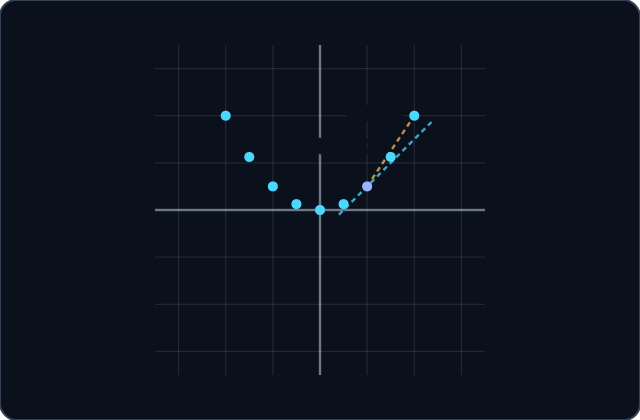
The dots trace a curve. The chord from to a nearby point has the average rate of change as its slope; as the second point slides towards the chords turn, and the derivative is the slope they turn towards.
The definition, in its two forms
is differentiable at when exists, and the limit is written . Substituting gives the equivalent form , which is often easier to compute. The quotient is undefined at the point in question and at no other, so a limit that ignores the value at the point is exactly what is needed.
Reading the definition
- The point must be an accumulation point of the domain, so a derivative at an endpoint of an interval is one-sided by force.
- is a number, not a function; is the function sending each point where the limit exists to that number.
- An equivalent statement: with . Differentiability is the existence of a good linear approximation.
The derivative of a square
Write down the quotient, simplify it away from the point, and take the limit. The numerator factors, and the factor that vanishes at the point cancels with the denominator — a cancellation that is legitimate precisely because the limit never evaluates at the point. What is left is a polynomial, whose limit is its value.
Proof steps
Write the difference quotient at the point.
Factor the numerator as a difference of two squares.
Cancel, which is legitimate because the limit only uses inputs different from the point.
A polynomial has its value as its limit.
So the limit exists at every point, and the derivative is the function doubling its input.
Applications
Practice
A Limit of Quotients
The derivative is the limit of average rates over shrinking stretches.
Try it
What is ?
Try it
For , what is ?
Try it
Why is not differentiable at ?
Try it
is a function.
Differentiable Means Well Approximated by a Line
The definition can be read as the existence of a linear approximation whose error vanishes faster than the step.
Try it
What does the error term in the linear approximation satisfy?
Try it
At the left endpoint of a closed interval the derivative is a one-sided limit.
Try it
. What is ?
What You Learned
- The derivative is the limit of the difference quotient at a point.
- The quotient is undefined at that point, which is why a limit is the right tool.
- is a number and is a function.
- Differentiability is the existence of a linear approximation with error vanishing faster than the step.
Final checkpoint
Try it
Which function is differentiable at ?
Try it
The difference quotient is undefined at , and this is a defect of the definition.
Completion
Lesson complete
Great work! You now know how to:
- Compute a derivative from the definition by factoring and cancelling
- Say why a limit that ignores the point is what the definition needs
- Read differentiability as the existence of a linear approximation
- Give a continuous function with no derivative at a point