Intuition
A function with a derivative at a point is continuous there, and the proof is three lines. The converse is false, and it fails badly: there are functions continuous everywhere with a derivative nowhere. The gap between the two conditions is the first place in this course where a picture is actively misleading, because every curve a hand can draw has a tangent almost everywhere and the general continuous function does not.
A road with no gaps in it may still have corners. Continuity forbids a jump; differentiability forbids a corner as well, and it forbids infinitely many other things besides — a road that is rough at every scale is continuous and has a direction nowhere.
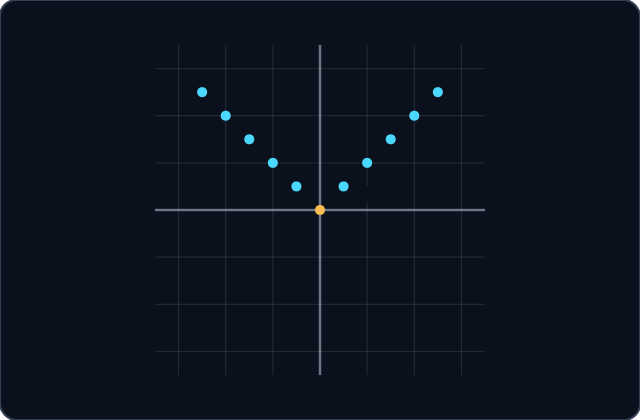
The dots trace . Nothing is torn, so the function is continuous everywhere; at the corner the chords from the left and from the right have slopes and , and no limit exists.
One implication, and how badly the other fails
If is differentiable at then is continuous at . The proof writes the difference of values as the quotient times the step and lets both factors take their limits. The converse fails at a corner, and worse: Weierstrass produced a function continuous on the whole line and differentiable at no point, which this course states and does not construct.
What each condition rules out
- Continuity forbids a jump. Differentiability forbids a corner, a vertical tangent and a wild oscillation as well.
- at is the standard corner; at has a vertical tangent, with the quotient tending to infinity.
Differentiable implies continuous
Write the difference of the values as the difference quotient multiplied by the step, which is legal away from the point and is exactly where the two are then evaluated. Each factor has a limit: the quotient by hypothesis, the step because it is a polynomial. The product rule for limits multiplies them, and one of the two limits is zero, so the difference of values tends to zero — which is continuity.
Proof steps
Multiply and divide by the step, which is legitimate for inputs other than the point.
The first factor by hypothesis and the second because it is a polynomial.
The product rule for limits, both factors having limits.
Which is exactly continuity at the point.
Applications
Practice
One Way Only
Differentiability is the stronger condition. Reading the implication backwards is the standard error.
Try it
is continuous at . What follows about ?
Try it
A function with a jump at a point has no derivative there.
Try it
In the proof, why is the difference of values multiplied and divided by the step?
Try it
is continuous at . Why is it not differentiable there?
Try it
A function continuous on the whole line is differentiable at all but finitely many points.
Try it
for and . What is true at ?
Try it
At how many points of the line does fail to be differentiable?
What You Learned
- Differentiability at a point implies continuity there.
- The converse fails at a corner, at a vertical tangent and at a wild oscillation.
- A continuous function may be differentiable nowhere.
- The contrapositive is the quickest way to rule out a derivative.
Final checkpoint
Try it
Differentiability is a strictly stronger condition than continuity.
Try it
for and for . What can be said at ?
Completion
Lesson complete
Great work! You now know how to:
- Prove that differentiability implies continuity
- Use the contrapositive to rule out a derivative
- Name three different ways a continuous function can fail to be differentiable
- Say why a picture of a general continuous function is misleading