Intuition
Over any interval a differentiable function has, at some interior point, an instantaneous rate equal to its average rate over the whole interval. It is Rolle with the interval tilted: subtract the chord and the two end values become equal again, so Rolle applies to the difference and its flat point is the point where the original function runs parallel to the chord.
A car that covers ninety miles in an hour was, at some instant, doing exactly ninety miles an hour. Nothing says when, and nothing says only once. The theorem is the reason a speed camera pair can issue a ticket without observing the moment.
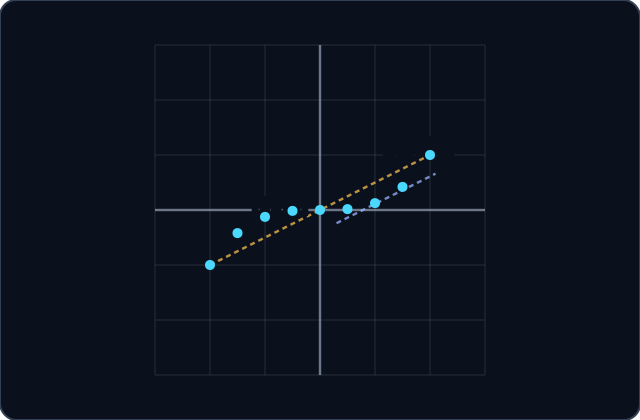
The chord joins the two end points; somewhere inside, the curve runs parallel to it. That point is what the theorem produces, and it is found by subtracting the chord and applying Rolle to what is left.
The statement, and the trick that proves it
If is continuous on and differentiable on , then there is a with . The proof applies Rolle to , where is the linear function agreeing with at both ends. Rolle is the special case in which the two end values already agree, so the chord is flat.
What it gives, and what it does not
- Rearranged: , which is the form used in almost every application.
The Mean Value Theorem
Tilt the picture until Rolle applies. Subtract from the function the linear function through its two end points: the difference has the value zero at both ends, so Rolle gives an interior point where its derivative vanishes. The derivative of the difference is the derivative of the function minus the slope of the chord, which is a constant, so vanishing means the two are equal at that point.
Proof steps
The linear function through the two end points.
Subtract it: the difference vanishes at both ends.
Rolle's theorem applies, since h inherits both hypotheses.
The chord has constant slope, so its derivative is that constant.
Setting the difference to zero at that point gives the statement.
Applications
Practice
Average Equals Instantaneous, Somewhere
The average rate over the interval is achieved as an instantaneous rate inside it.
Try it
What does the theorem produce?
Try it
on . At which point does equal the average rate?
Try it
How is the theorem reduced to Rolle?
Try it
The point the Mean Value Theorem produces is unique.
The Working Form
Rearranged, the theorem bounds a change by a bound on the rate.
Try it
on . What bound does the theorem give on ?
Try it
The theorem needs differentiability at the endpoints of the interval.
Try it
on . What is the average rate of change over the interval?
What You Learned
- Somewhere inside, the instantaneous rate equals the average rate.
- The proof subtracts the chord and applies Rolle.
- The point is not identified and need not be unique.
- The working form converts a bound on the derivative into a bound on the change.
Final checkpoint
Try it
is differentiable on with and . What does the theorem guarantee?
Try it
A point moving in the plane and returning to its start must have an instant of zero velocity.
Completion
Lesson complete
Great work! You now know how to:
- State the theorem and its two hypotheses
- Prove it by subtracting the chord and applying Rolle
- Use the working form to bound a change by a bound on the rate
- Say what the theorem does not claim