Intuition
When the characteristic equation has two different real roots, the equation has two exponential solutions, one growing or decaying at each rate, and every solution is a combination of them. The long run is read off the signs: two negative roots mean every solution dies away, a positive root means almost every solution grows, and the larger root wins in the end.
Two savings accounts, one at a higher rate. Whatever the starting amounts, after long enough the higher-rate account holds almost everything, and the total grows at its rate.
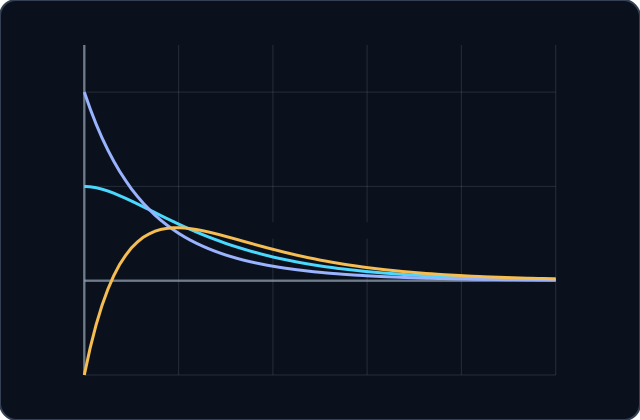
Solutions of , whose roots are and . Every solution is , so every one dies away, and it can cross zero at most once on the way.
Two exponentials, and which one wins
If has real roots , the general solution of is . The two exponentials are linearly independent, since their ratio is not constant, and the lesson on the Wronskian shows that two independent solutions give every solution.
Reading the solutions
- : roots and , so .
The larger rate dominates
Take the exponential with the larger rate out as a factor. What remains in the bracket is its coefficient plus the other coefficient times an exponential with a negative rate, and that exponential tends to zero. So the solution divided by its leading term tends to one: in the long run the solution looks like its term with the larger rate, provided that term is present.
Proof steps
Take the exponential with the larger rate out as a factor.
The remaining exponent is negative, so its exponential tends to zero.
So the bracket tends to the coefficient of the leading term.
Dividing by the leading term, the solution behaves like it in the long run.
Applications
Practice
Two Roots, Two Exponentials
Each real root gives an exponential solution, and the general solution combines them.
Try it
What is the general solution of ?
Try it
If both characteristic roots are negative, every solution tends to zero.
Try it
What is the general solution of ?
Try it
For , what is the limit of as ?
Independence, Briefly
Two functions are linearly independent when neither is a constant multiple of the other: only zero coefficients make a combination of them vanish everywhere.
Try it
Which pair of functions is linearly independent?
Try it
and are another pair of independent solutions of .
Try it
The solution crosses zero exactly once. What is at that point?
Try it
For , which solutions stay bounded as ?
Final checkpoint
Try it
The characteristic roots of an equation are and . What do its solutions do as grows?
Try it
A nonzero solution of an equation with two distinct real characteristic roots crosses zero at most once.
Try it
For with , and , what is ?
Completion
Lesson complete
Great work! You now know how to:
- write the general solution when the characteristic roots are real and distinct
- read the long-run behaviour off the signs of the roots
- prove that the larger rate dominates
- check that two exponentials with different rates are independent