Intuition
When the discriminant is negative the roots are a complex pair, and their exponentials are complex-valued. Euler's formula rewrites them, and their real and imaginary parts are two real solutions: an exponential times a cosine, and the same exponential times a sine. The imaginary part of the root is a frequency, and the real part decides whether the oscillation grows, holds or dies.
A playground swing left to itself. It goes back and forth, and friction makes each swing a little smaller than the last: an oscillation inside a shrinking envelope. The imaginary part of the root is how fast it swings; the real part is how fast the envelope shrinks.
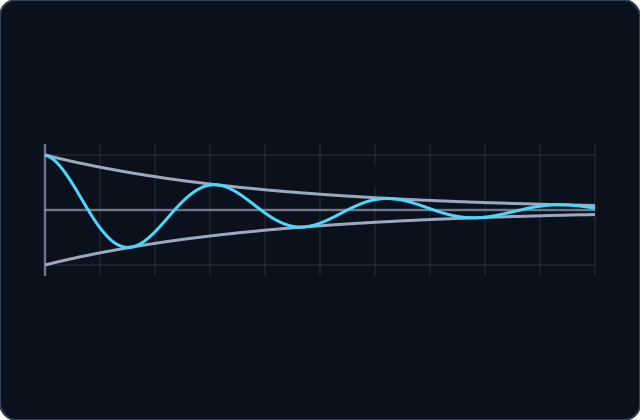
A solution of , whose roots are : it is , an oscillation of frequency inside the envelope set by the real part.
Real solutions from a complex pair
If has roots with , the general real solution of is . Euler's formula, taken here as known, gives , and because the equation has real coefficients the real and imaginary parts of a complex solution are real solutions.
Reading an oscillation
- : , so .
Real and imaginary parts of a complex solution are solutions
The operator is linear and its coefficients are real, so applied to u plus i v it gives L of u plus i times L of v, with L of u and L of v both real functions. A complex number is zero only when its real and imaginary parts are both zero. So each part solves the equation on its own.
Proof steps
Euler's formula splits the complex solution into a real part and an imaginary part.
L is linear with real coefficients, so L of u and L of v are real functions.
The complex exponential solves the equation, because its rate is a root.
A complex number is zero only if both its parts are, so both parts are real solutions.
Applications
Practice
A Complex Pair Gives Sines and Cosines
For roots , the real part becomes an exponential envelope and the imaginary part a frequency.
Try it
What is the general solution of ?
Complex Roots, Briefly
With , a negative discriminant gives , and the quadratic formula still works.
Try it
What are the roots of ?
Try it
Every nonzero solution of oscillates for ever with the same amplitude.
Try it
For , what is the frequency of the oscillation?
Try it
The characteristic roots are . What do the solutions do?
Try it
An equation with real coefficients and complex characteristic roots has only complex-valued solutions.
Try it
Write as . What is ?
Try it
Solve with and .
Final checkpoint
Try it
Which equation has solutions that oscillate and die away?
Try it
Every nonzero solution of crosses zero at intervals of .
Try it
For , the solutions lie inside an envelope . What is ?
Completion
Lesson complete
Great work! You now know how to:
- find a complex pair of characteristic roots
- write the real general solution from its real and imaginary parts
- read growth, decay or steady oscillation off the real part
- combine a cosine and a sine into one amplitude and phase