Intuition
For a homogeneous linear equation, solutions can be added and multiplied by constants and they remain solutions. This is superposition, and it is why linear equations are tractable: find two independent solutions and every combination of them is available. It fails the moment the equation is forced or nonlinear, and the ways it fails are as instructive as the principle.
Two ripples on a pond pass through each other and add, each carrying on afterwards as if the other had not been there. Small water waves obey a linear equation, and superposition is what the eye sees.
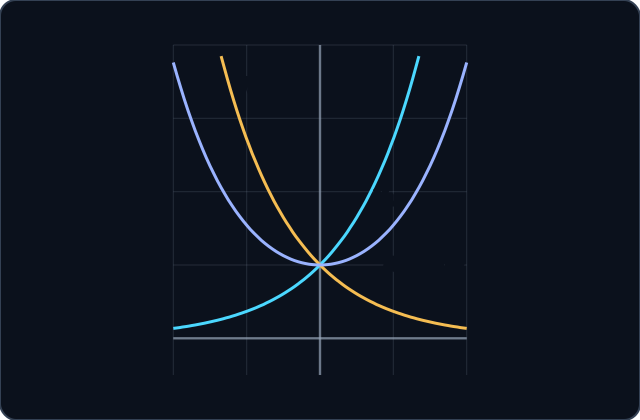
For , and are solutions, and so is any combination: here their average . Every solution is .
Combinations of solutions are solutions
Write . Then for any functions and constants: is linear in the sense of the linear algebra course. So the solutions of form a vector space of functions, and every solution of the forced equation is one particular solution plus a solution of .
Where it holds, and where it fails
- and solve , so does too.
The superposition principle
Differentiation is linear: the derivative of a combination is the same combination of the derivatives, once and then again. Multiplying by p or by q distributes over the combination. So L of the combination is the combination of L of each function, and each of those is zero.
Proof steps
Differentiation is linear, once and twice.
Substitute and collect the terms belonging to each function.
Each bracket is L applied to one of the two functions.
Both functions solve the homogeneous equation, so the combination does too.
Applications
Practice
Add and Scale
Solutions of a homogeneous linear equation can be added and multiplied by constants, and remain solutions.
Try it
Given that and solve , which of these also solves it?
Try it
If and both solve , then so does .
Try it
solves . Does ?
Try it
The zero function solves every homogeneous linear equation.
Try it
and solve . For , what is ?
Try it
solves , and , solve . What is the general solution of ?
Try it
If and for the same linear , then .
A Reminder from Linear Algebra
A subspace is a set of vectors that contains zero and is closed under addition and scalar multiplication. Functions can be vectors: they add and they scale.
Try it
Which set of functions is a subspace, in the sense of the linear algebra course?
Final checkpoint
Try it
Why does solve , given that and do?
Try it
The product of two solutions of a homogeneous linear equation is always a solution.
Try it
solves for every . What is when ?
Completion
Lesson complete
Great work! You now know how to:
- combine solutions of a homogeneous linear equation into new ones
- prove the superposition principle from the linearity of differentiation
- say why it fails for forced and for nonlinear equations
- write a general solution as a particular solution plus a homogeneous one