Intuition
Newton's law puts a second derivative into physics: force is mass times acceleration, and acceleration is the second derivative of position. An equation in the second derivative remembers more than a first-order one — not only where the solution is, but which way it is heading — and so it needs more to pin a solution down: a value and a slope at the starting point. This chapter is about the linear ones, where that pair of numbers always picks exactly one solution.
Knowing where a thrown ball is at one instant tells you nothing about where it will land. Knowing where it is and how fast and in what direction it is moving tells you everything. A second-order equation needs that second piece of information, and only that.
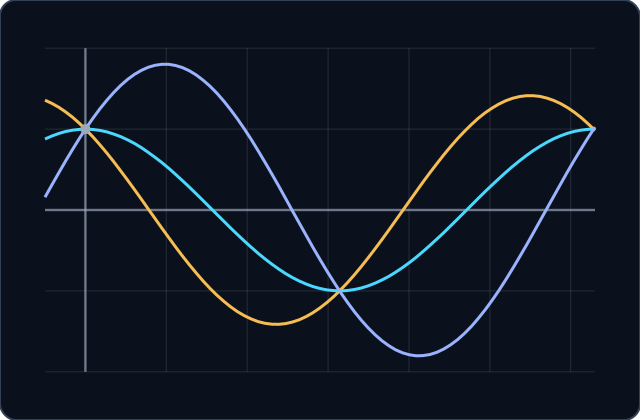
Three solutions of , all passing through , with slopes , and there. The value alone does not pick a solution; the value and the slope together do.
Standard form, and what determines a solution
A second-order linear equation can be written . It is homogeneous when . It has constant coefficients when it can be written with numbers , , . If , and are continuous on an interval containing , then for every value and slope there is exactly one solution with and , and it exists on the whole interval.
Reading an equation
- Linear means , and appear to the first power, each multiplied by a function of the input: is linear, is not.
A value and a slope determine one solution
This is the second-order form of the existence and uniqueness theorem of the first chapter, and it is used here without proof: the proof writes the equation as a pair of first-order equations and repeats the successive approximations behind the first-order theorem. What it says is what the physics suggests — a mass on a spring released from a given place with a given velocity moves in one way only — and it is what makes a two-constant family of solutions the whole answer.
Applications
Practice
Second Order, Still Linear
A second-order linear equation has , and to the first power, each multiplied by a function of the input.
Try it
Which of these is a second-order linear equation?
Two Conditions for Order Two
A second-order equation needs a value and a slope at the starting point to pick out one solution.
Try it
For , the condition alone picks out exactly one solution.
Try it
Which of these second-order linear equations is homogeneous?
Try it
Put in the form . What is ?
Try it
A mass on a spring obeys . Why does it need two initial conditions?
Try it
If , and are continuous on an interval containing , the problem , , has exactly one solution on that interval.
Try it
Which equation has constant coefficients?
Try it
How many arbitrary constants does the general solution of a second-order linear equation contain?
Final checkpoint
Try it
Which function solves ?
Try it
Two different solutions of , with continuous and , can have the same value and the same slope at a point.
Try it
For which does solve ?
Completion
Lesson complete
Great work! You now know how to:
- recognise a second-order linear equation and put it in standard form
- say why it needs a value and a slope to pick one solution
- tell homogeneous from forced, and constant coefficients from variable ones
- check a proposed solution by differentiating twice