Intuition
For an equation with constant coefficients there is a natural guess: an exponential, because differentiating an exponential only multiplies it by its rate. Substituting it turns the differential equation into an algebraic one, a quadratic for the rate, and the next three lessons are about what its roots say.
A tuning fork rings at frequencies set by its shape, not by how it is struck. The roots of the characteristic equation are the rates the equation rings at, fixed by the coefficients alone.
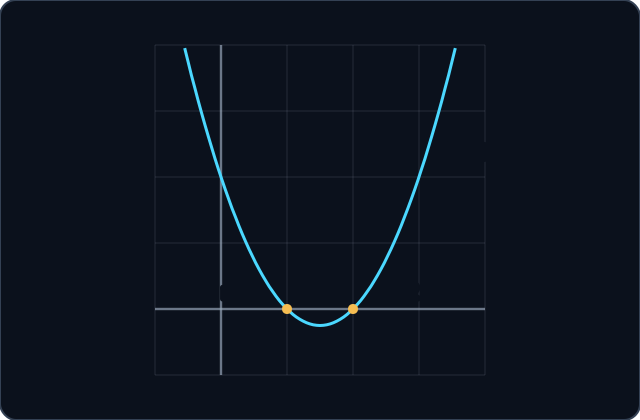
The characteristic polynomial of is . Its roots, and , are the rates of the two exponential solutions and .
Guess an exponential, get a polynomial
Write . Substituting gives . An exponential is never zero, so is a solution exactly when is a root of the characteristic equation . Its discriminant sorts every such equation into three cases: two real roots, one repeated root, or a complex pair.
Writing it, and the three cases
- : , so and are solutions.
An exponential solves exactly when its rate is a root
Differentiate the exponential once and twice: each derivative multiplies it by r. Substitute and take the exponential out as a common factor. What is left is the characteristic polynomial evaluated at r, times an exponential that is never zero, so the whole is zero exactly when r is a root.
Proof steps
Each derivative of the exponential multiplies it by r.
Substitute and take out the common factor.
An exponential never vanishes.
So the exponential solves the equation exactly when r is a root of the characteristic polynomial.
Applications
Practice
Carry the Coefficients Across
Replace by , by and by .
Try it
What is the characteristic equation of ?
Try it
has solutions and . What is the larger rate?
Try it
can solve even if is not a root of .
Try it
What is the characteristic equation of ?
Three Cases
The discriminant of the characteristic equation decides the shape of every solution.
Try it
Which case does fall into?
Try it
The guess solves for a suitable constant .
Try it
What is the discriminant of the characteristic equation of ?
Try it
Which equation has characteristic roots and ?
Final checkpoint
Try it
Why is an exponential the natural guess for a constant-coefficient equation?
Try it
The same substitution solves , giving .
Try it
What is the product of the characteristic roots of ?
Completion
Lesson complete
Great work! You now know how to:
- write the characteristic equation of a constant-coefficient equation
- prove that an exponential solves it exactly when its rate is a root
- sort an equation into one of the three cases by its discriminant
- say why the method needs constant coefficients