Intuition
With the general solution in hand, a value and a slope at the starting point give two linear equations for the two constants. Solving them is a small piece of linear algebra, and it always works — the next lesson explains why the system is never singular. What does not always work is asking for values at two different points: that is a boundary value problem, and it can have one solution, none, or infinitely many.
A shell fired from a gun: where the gun stands, with the angle and speed of the shot, determines the whole flight. Asking instead for the shell to land on a particular spot fixes a condition at the far end, and depending on the target there may be two firing angles, one, or none.
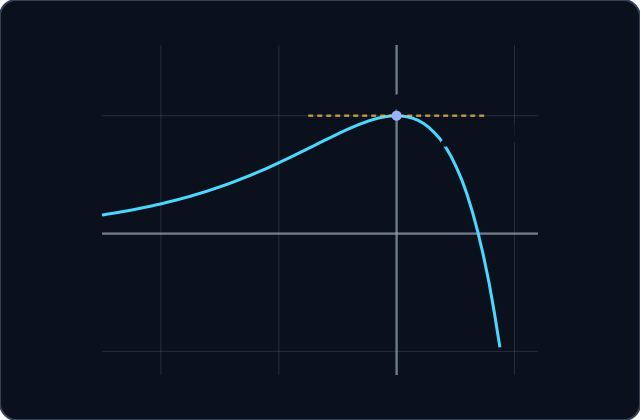
The solution of with and is . The value fixes the point and the slope fixes the tangent there; of the whole two-constant family, exactly one curve does both.
Two conditions, two equations
For with and , the constants solve the linear system below. When and are independent solutions its determinant, the Wronskian of the next lesson, is not zero, so the system has exactly one solution.
Doing it right
- , , : and , so , and .
Applications
Practice
Differentiate, Then Substitute
Write the general solution and its derivative, put the starting point into both, and solve the two equations.
Try it
Solve with and .
Try it
For with and , the solution is . What is ?
Try it
The boundary value problem , , has exactly one solution.
Try it
Solving with , , a student writes and . What went wrong?
Try it
For with and , what is ?
Try it
For with and , which is the solution?
Try it
For a second-order linear equation with continuous coefficients, every choice of and gives exactly one solution.
Try it
For how many constants does satisfy and ?
Final checkpoint
Try it
With and conditions at , what is the matrix of the system for and ?
Try it
satisfies , and .
Try it
For with and , the solution is . What is ?
Completion
Lesson complete
Great work! You now know how to:
- turn a value and a slope into two equations for the constants and solve them
- write the system as a matrix equation
- choose a convenient pair of solutions to make the algebra easy
- tell an initial value problem from a boundary value problem, and why the latter can fail