Intuition
The Laplace transform turns a function of time into a function of a new variable, s, by weighting it with a decaying exponential and adding up the result over all positive time. What makes it worth doing is what it does to derivatives: differentiation in time becomes multiplication by s, so a linear differential equation with constant coefficients becomes an algebraic equation, with its initial conditions built in. Solve the algebra, transform back, and the problem is done.
Logarithms turn multiplication into addition, so a hard multiplication becomes an easy addition and a look-up in a table. The Laplace transform turns differentiation into multiplication in the same way, and its table of transforms is the look-up.
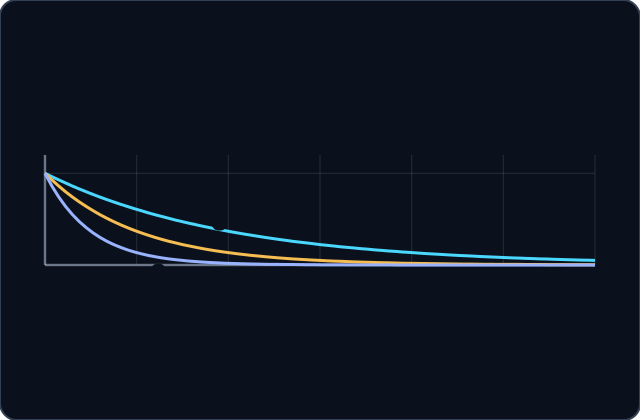
The transform of the constant is the area under the weight , which is : , and for these three values of . The larger , the faster the weight dies and the less of a function's future the transform sees.
An integral against a decaying exponential
For a function defined for , its Laplace transform is the function below, defined at every where the improper integral converges. When is piecewise continuous and of exponential order, for some constants and , the integral converges for every . The transform is linear: .
First transforms
- for .
The transform of an exponential
Combine the two exponentials into one, with rate s minus a, and integrate it up to a finite time T. When s exceeds a, the exponential at T dies as T grows, so only the value at zero survives, and it gives one over s minus a. For s at or below a the integral diverges, which is why the transform is defined only to the right of a.
Proof steps
Combine the two exponentials.
An improper integral is a limit of proper ones.
The exponential dies as T grows when s exceeds a.
Only the lower limit contributes.
Applications
Practice
Weight and Add Up
Multiply f by the decaying exponential and integrate over all positive time. The answer is a function of s.
Try it
What is ?
Try it
What is at ?
Try it
.
Try it
For which does exist?
Try it
What is at ?
Try it
Every continuous function on has a Laplace transform for large enough .
Try it
Which function is of exponential order?
Try it
. What is the value of the constant function ?
Final checkpoint
Try it
What happens to as , for piecewise continuous and of exponential order?
Try it
Two functions that agree for every but differ for have the same Laplace transform.
Try it
What is at ?
Completion
Lesson complete
Great work! You now know how to:
- define the Laplace transform and say where it exists
- compute the transforms of constants and exponentials
- prove the transform of an exponential
- use linearity to transform a combination