Intuition
The method has three steps. Transform the equation, turning derivatives into powers of s and bringing the initial values in; solve the resulting algebraic equation for the transform of the solution; and invert, usually after partial fractions, reading the answer off the table. The same three steps work for every linear equation with constant coefficients, forced or not: the forcing simply adds its own transform to the algebra.
Translating a hard text into a language in which it is easy, working there, and translating the answer back. The translations are the transform and its inverse, and the easy language is algebra.
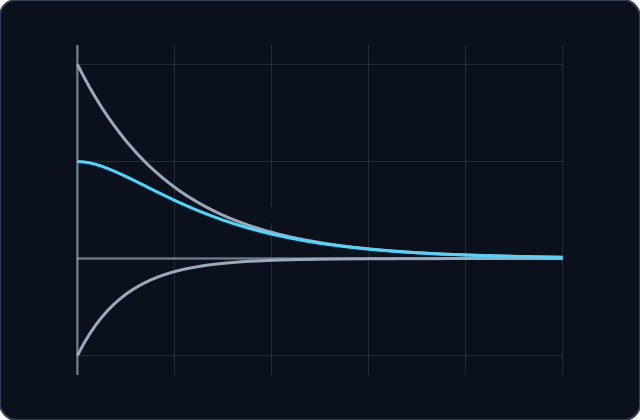
, , . The transform inverts term by term to , drawn with its two terms dashed: each partial fraction is one exponential.
Transform, solve, invert
For with and given: transform both sides with the rules for derivatives; solve for , which is a ratio of polynomials when the transform of is; split it into partial fractions; and invert each fraction with the table. The denominator of holds the characteristic polynomial, so its roots are the characteristic roots of chapter four, together with those of .
Worked in three steps
- , , : , so and .
Every such problem becomes one algebraic equation
Transform the equation term by term. Each derivative becomes a power of s times the transform of the solution, less terms made of the initial values. Collecting the terms in the transform leaves the characteristic polynomial times it on one side, and the transform of the forcing with the initial terms on the other; dividing gives the transform of the solution explicitly.
Proof steps
Transform each term with the rules for derivatives.
Collect the terms in Y.
Divide by the characteristic polynomial.
Applications
Practice
Using the Three Transform Steps
Transform the equation, bringing in the initial values; solve the algebra for Y; split Y into partial fractions and invert each with the table.
Try it
What is the right order of the three steps of the method?
Try it
Solve , , by the transform. What is ?
Try it
For , the transform of the solution has the characteristic polynomial in its denominator.
Try it
, , . What is ?
Try it
. What is ?
Try it
A factor in the denominator of produces a term in the solution.
Try it
, . What is ?
Try it
For , , the solution is . What is ? Give two decimal places.
Final checkpoint
Try it
from rest gives . What does the repeated factor mean for ?
Try it
The transform method, with the table, solves on .
Try it
For , , , the method gives . As a check, what is from this formula?
Completion
Lesson complete
Great work! You now know how to:
- solve an initial value problem in three steps
- derive the transformed equation for any second-order problem
- invert with partial fractions and the table
- recognise repeated roots and resonance in the transform