Intuition
With the step function, a forcing that switches on and off becomes one formula, and the transform handles it without solving on each piece separately and matching the pieces up. The solution comes out as a sum of delayed responses, each switched on when its piece of forcing starts. Even when the forcing jumps, the solution of a second-order equation stays smooth: it is the acceleration that jumps, not the position or the velocity.
Pushing a swing for a few seconds and letting go. The push switches on and off, but the swing never jumps: it gathers speed while the push lasts, and swings on freely afterwards.
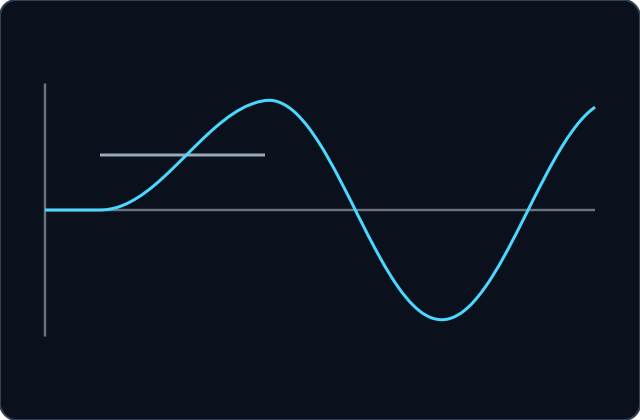
from rest: a push of size from to . The response is smooth at both switches, and after the push the spring swings freely.
One formula for a switched problem
To solve with switched on and off: write with steps, transform it — each piece switched on at gains a factor — solve for , and invert each term, keeping its exponential as a delay. If is the response from rest to a unit step switched on at , the response to one switched on at is delayed by . The answer holds for all at once, and and are continuous at every switch: the jump of appears only in .
Switched problems
- from rest: , so and .
A delayed switch gives a delayed response
Transform both problems. From rest, the transform of each solution is the transform of its forcing divided by the characteristic polynomial. The delayed step’s transform is the undelayed one times e to the minus cs, so the same factor multiplies the solution’s transform, and by the second shifting rule that factor is a delay.
Proof steps
The step response from rest: the step at 0 has transform 1/s.
The delayed step has transform e to the minus cs over s.
By the second shifting rule, the factor is a delay.
Applications
Practice
Switched Forcing, One Formula
Write the forcing with steps; each piece switched on at c brings a factor e to the minus cs into the transform.
Try it
from rest. What is ?
Try it
, . What is ?
Try it
For from rest, is continuous at .
Try it
Which function solves from rest?
Try it
. What is ? Give two decimal places.
Try it
Solving a switched problem piece by piece, matching the value and the derivative at the switch, gives the same solution as the transform.
Try it
from rest. What is for ?
Try it
. By how much does jump at ?
Final checkpoint
Try it
What does the transform save, compared with solving a switched problem piece by piece?
Try it
When the forcing of jumps, the solution jumps too.
Try it
, . What value does approach as ?
Completion
Lesson complete
Great work! You now know how to:
- solve a switched problem in one formula
- prove that a delayed switch gives a delayed response
- say which derivative of the solution carries a jump
- find the free motion that follows a push