Intuition
A linear system answers an impulse with its impulse response, and any forcing can be thought of as a stream of impulses, one at every instant, each as large as the forcing is then. The response to all of them is the sum of the impulse responses they set off, each delayed to its own instant. That sum is an integral, the convolution of the forcing with the impulse response, and its transform is simply the product of the two transforms.
The echo in a large hall. Every sound adds its own fading echo, and what you hear at any moment is the sum of the echoes of everything said before, each faded by how long ago it was said.
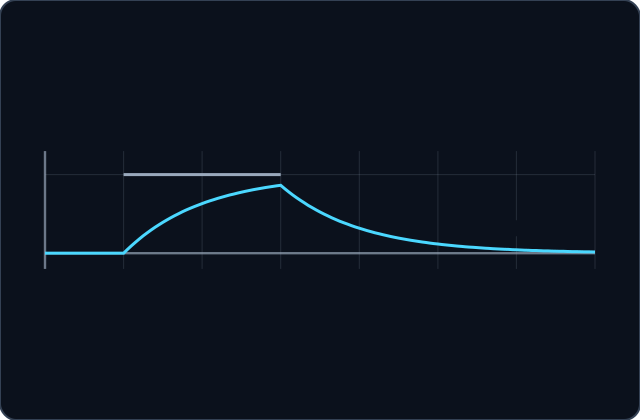
from rest, with a pulse from to . The response is the convolution : each instant of the pulse sets off an impulse response , delayed to that instant, and their sum rises while the pulse lasts and fades after it.
The response as an integral
The convolution of and is the function below. It is symmetric, , and its transform is the product . So the solution from rest of is , where is the impulse response: each value is an impulse at , answered by , and the integral adds them up.
Using convolution
- , and indeed .
The convolution theorem
Write the transform of the convolution as a double integral over the region where tau runs from zero to t. Exchange the order: for each tau, t runs from tau to infinity. Shift the inner variable so that it starts at zero; it produces e to the minus s tau times the transform of g. The outer integral is then the transform of f, times the transform of g.
Proof steps
Write out the transform of the convolution.
Exchange the order of integration over the region where tau lies between 0 and t.
Shift the inner variable to start at zero.
What remains outside is the transform of f.
Applications
Practice
Products of Transforms
The transform of a convolution is the product of the transforms, so a product of transforms inverts to a convolution.
Try it
Which function has the transform ?
Try it
What is at ?
Try it
for the ordinary product of two functions.
Try it
from rest. Which formula gives for every forcing ?
Try it
What is at ?
Try it
.
Try it
In , what does describe?
Try it
Invert as the product and evaluate at . Give two decimal places.
Final checkpoint
Try it
Why is the convolution formula useful for a forcing measured as data?
Try it
solves whatever the initial values.
Try it
What is at ?
Completion
Lesson complete
Great work! You now know how to:
- compute a convolution and its transform
- prove the convolution theorem
- write the response to any forcing with the impulse response
- invert a product of transforms without partial fractions