Intuition
A hammer blow, a kick, a sudden charge: a force so short and so large that only its total effect matters. Model it as a pulse of fixed area squeezed into a shorter and shorter time; in the limit it becomes the delta function, zero except at one instant and with area one. It is not a function in the ordinary sense, but its transform is simply an exponential, and in a mechanical system an impulse simply changes the velocity at one instant.
A cricket ball struck by a bat. The contact lasts about a thousandth of a second and the force during it is enormous, but all that matters afterwards is the change in the ball’s momentum — the impulse.
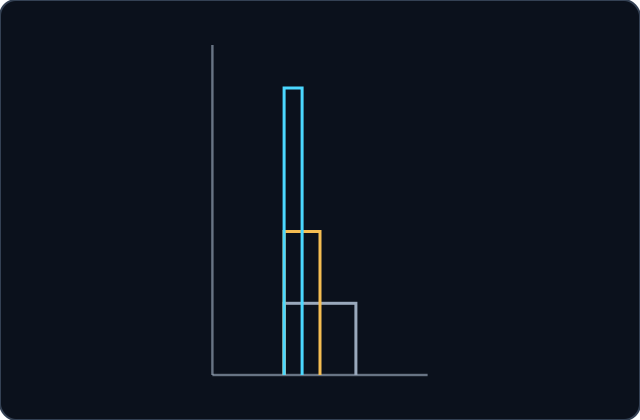
Pulses of area starting at , each half as long and twice as tall as the last. Their limit is the delta function : no width, and still area .
An impulse of area one
The delta function is the limit of the pulses as : zero away from , and with area . What makes it usable is the sifting property below, which says what it does inside an integral; its transform is . In the impulse changes the velocity at by and leaves the position unchanged.
Working with impulses
- , by sifting with .
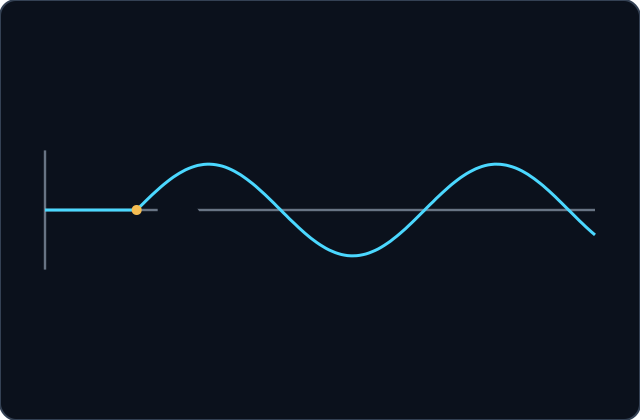
from rest: . The position never jumps; the velocity jumps from to at the kick, which is the corner in the graph.
The transform of an impulse
Take a pulse of area one and width epsilon, starting at c. Its transform is the difference of two step transforms, and it factors as e to the minus cs times a ratio. As epsilon shrinks the ratio tends to one, because it is a difference quotient of an exponential at zero. So the transforms of ever narrower pulses approach e to the minus cs, and that limit is what the transform of the delta function means.
Proof steps
A pulse of width epsilon and height one over epsilon has area one.
Transform the two steps and take out the common factor.
A difference quotient: the derivative of one minus e to the minus x at zero, which is one.
The limit is taken as the transform of the impulse.
Applications
Practice
Area One, No Width
The delta function is the limit of pulses of area one squeezed into an instant. Inside an integral it picks out the value at that instant.
Try it
What is ?
Try it
What is ?
Try it
Each pulse has area , whatever .
Try it
from rest. What is ?
Try it
A mass at rest is struck by an impulse . By how much does its velocity change at ?
Try it
An impulse makes the position of a mass on a spring jump.
Try it
The impulse response solves from rest. What is ?
Try it
The impulse response of is . What is ?
Final checkpoint
Try it
What is the delta function?
Try it
.
Try it
from rest. What is the amplitude of the motion after the kick?
Completion
Lesson complete
Great work! You now know how to:
- model a blow as a delta function
- derive its transform as a limit of pulses
- solve a kicked problem and find the jump in velocity
- find an impulse response from the characteristic polynomial