Intuition
Real forcing is often switched: a voltage turned on at one moment and off at another, a load placed on a beam and later removed. The unit step function, zero before a given time and one after it, is the switch. Multiplying a function by a step turns it on at that time, and differences of steps build pulses. The transform of a step is simple, and so is the rule that switching a function on later multiplies its transform by a decaying exponential.
A light switch. The step is the switch itself: off, then on, with nothing in between. Any schedule of switching on and off is built from a few of them.
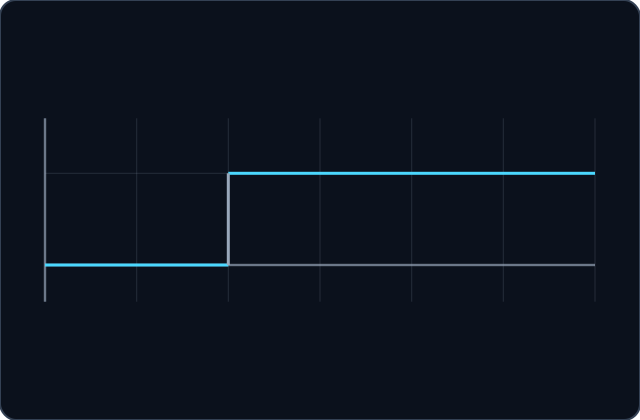
The unit step : before and from then on. The dashed line only marks the jump; the function takes no values between and .
Switching on and off
The unit step is for and for . A function switched on at is , and a pulse from to is . Delaying a function by and switching it on then multiplies its transform by ; to use the rule, the function must first be written in terms of .
Working with steps
- for .
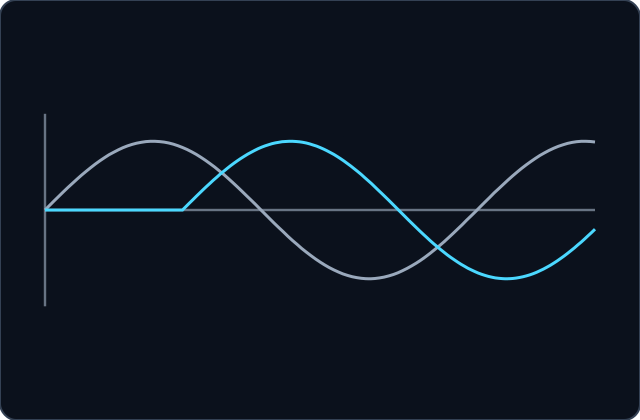
, dashed, and : the same function delayed by and switched off before then. Its transform is .
The second shifting rule
The step is zero before c, so the integral starts at c. Shift the variable so that it starts at zero again: the exponential weight splits into a constant factor, e to the minus cs, and the weight that the transform of f uses. The integral that remains is the transform of f.
Proof steps
The step removes everything before c.
Substitute tau for t − c.
The constant factor comes out, and what remains is the transform of f.
Applications
Practice
The Unit Step
The unit step is 0 before time c and 1 from c on. Multiplying by it switches a function on at c.
Try it
What are at and at ?
Try it
. What is ?
Try it
equals for and otherwise.
Try it
What is ?
Try it
. What is its inverse at ?
Try it
.
Try it
is for and for . Which formula is it?
Try it
What is the transform of the pulse at ? Give two decimal places.
Final checkpoint
Try it
What does a factor in a transform mean for the function?
Try it
The unit step is continuous at .
Try it
. What is ?
Completion
Lesson complete
Great work! You now know how to:
- write a switched function with unit steps
- prove the second shifting rule
- transform and invert delayed functions
- build a pulse from two steps