Intuition
Drive an oscillator at its own natural frequency and each push arrives just when it helps most. Without friction the amplitude then grows without bound — the particular solution is t times a sine, the modification rule of undetermined coefficients in physical form. Close to the natural frequency the motion beats, swelling and fading; with friction the amplitude stays finite but peaks sharply near the natural frequency.
Pushing a swing. Push at random moments and little happens; push once a swing, at the top, and even small pushes build a large swing. A wineglass shattered by a sung note and a footbridge set swaying by walkers in step are the same arithmetic.
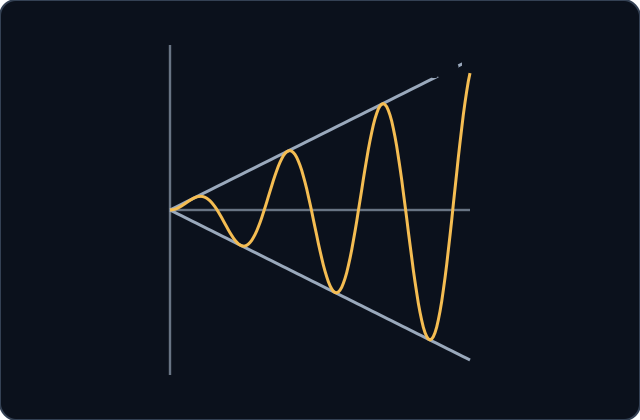
, driven at its own frequency and started at rest: , an oscillation whose amplitude grows in proportion to time.
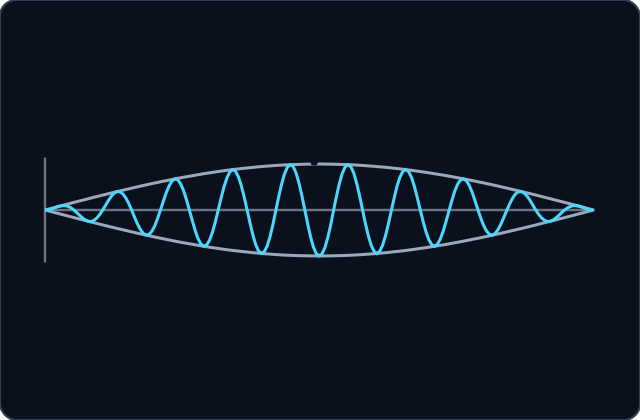
from rest: , a fast oscillation inside a slow envelope that swells and fades — beats, with a loud-and-quiet cycle every .
Pure resonance, beats and a finite peak
For with , , whose amplitude blows up as . At the plain guess solves the homogeneous equation, the modification rule applies, and grows without bound. With damping the amplitude is finite for every , and largest near when is small.
What resonance does
- Near resonance, from rest, , a fast oscillation inside a slow envelope: beats.
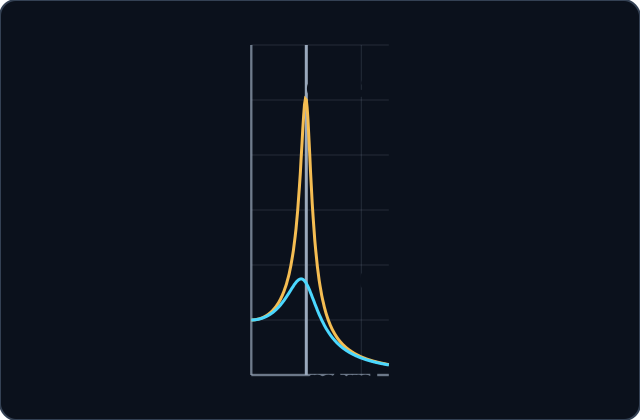
The steady amplitude of against the driving frequency , for and . Both peak near the natural frequency , and the lighter the damping the taller and narrower the peak.
At resonance the response grows linearly
The plain guess solves the homogeneous equation, so the modification rule multiplies it by t; the cosine part of the modified guess turns out to have coefficient zero, so try t times a sine. Differentiating twice by the product rule gives twice omega times a cosine, minus omega squared times t times a sine. Adding omega squared times the trial cancels the terms in t and leaves twice omega times B times the cosine, which must equal the forcing. That fixes B, and the amplitude grows in proportion to t.
Proof steps
The modification rule: the plain guess solves the homogeneous equation, so multiply by t.
Differentiate twice by the product rule.
The terms in t cancel.
Matching the forcing fixes the coefficient.
Applications
Practice
Driving at the Natural Frequency
resonates when : the forcing then solves the homogeneous equation.
Try it
Which forcing makes resonate?
Try it
For , the resonant particular solution is . What is ?
Try it
With friction , the steady amplitude of a driven oscillator is finite at every driving frequency.
Try it
What is heard when an undamped oscillator is driven close to, but not exactly at, its natural frequency?
Try it
For , the particular solution is . What is ?
Try it
At exact resonance without friction, the amplitude grows in proportion to time.
Try it
For a lightly damped oscillator driven at resonance, halving the friction does what to the amplitude?
Try it
Driven at with , the loud-and-quiet cycle of the beats repeats every . To the nearest whole number, how long is that?
Final checkpoint
Try it
Why does the resonant particular solution carry a factor of t?
Try it
Driving a lightly damped structure at its natural frequency is harmless as long as the force is small.
Try it
A lightly damped oscillator with , and is driven at resonance. Using , what is its amplitude?
Completion
Lesson complete
Great work! You now know how to:
- recognise resonance and find the growing particular solution
- explain beats as two close frequencies adding
- say why damping keeps the amplitude finite and how the peak depends on it
- read an amplitude curve against the driving frequency