Intuition
A forced equation has exactly one solution for each value and slope, just as the homogeneous one does — but the whole family is shifted. Every solution is one particular solution of the forced equation plus the general solution of the homogeneous one. So solving a forced equation is two jobs: the homogeneous job, which the last chapter finished for constant coefficients, and finding just one solution of the forced equation, which the next two lessons do by two different methods.
An address. A particular solution gets you to the right street, and the homogeneous solutions say which house. Any street on the map will do as a start, provided every way of moving along it is then added.
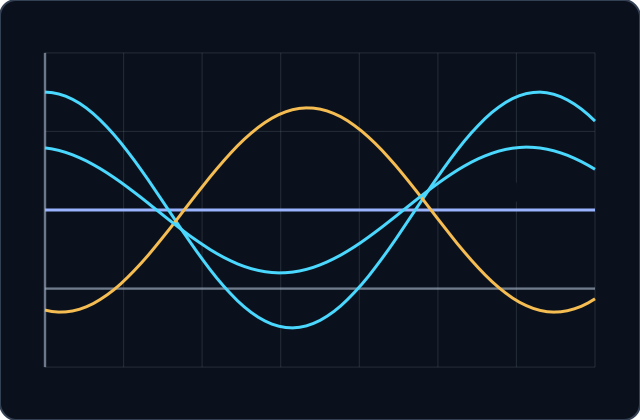
Solutions of . The constant is one solution, and every other is : the oscillations of the homogeneous equation, centred on the particular solution instead of on zero.
One particular solution, plus all the homogeneous ones
If is any one solution of and , are independent solutions of , then every solution of is . The constants are found last, from the conditions, after has been added — never before.
Working with it
- : by inspection, so .
Every solution is a particular solution plus a homogeneous one
Subtract the particular solution from any solution. By linearity the difference solves the homogeneous equation, and the solutions of the homogeneous equation are exactly the combinations of a fundamental pair, by the theorem of the Wronskian lesson. Adding the particular solution back gives the form claimed.
Proof steps
By linearity the difference of the two solutions solves the homogeneous equation.
Every homogeneous solution is a combination of a fundamental pair.
Adding the particular solution back gives every solution of the forced equation.
Applications
Practice
Particular Plus Homogeneous
Every solution of a forced linear equation is one particular solution plus the general solution of the homogeneous equation.
Try it
solves , and , solve . What is the general solution of ?
Try it
Any particular solution will do: choosing a different one gives the same general solution.
Try it
Solving with and , a student applies to and gets . What is wrong?
Try it
For which constant is a solution of ?
Try it
solves and solves . Which is a particular solution of ?
Try it
The solutions of form a subspace.
Try it
Solve with and . What is ?
Try it
Which function is a particular solution of ?
Final checkpoint
Try it
Solving a forced linear equation splits into which two jobs?
Try it
The difference of two solutions of solves .
Try it
How many arbitrary constants does the general solution of contain?
Completion
Lesson complete
Great work! You now know how to:
- write every solution of a forced equation as a particular one plus a homogeneous one
- prove that nothing else can be a solution
- split a forcing into pieces and add their responses
- apply the conditions to the whole solution, last