Intuition
Hang a mass on a spring and pull it down. Hooke's law says the spring pulls back with a force proportional to the stretch; friction, if there is any, resists in proportion to the speed; and anything else pushing on the mass is the forcing. Newton's law adds these up into a second-order linear equation with constant coefficients — the mass, the friction and the stiffness — in which each of the three numbers means something you could point to.
A car on its springs and shock absorbers. The springs push back, the dampers resist motion, and the road does the forcing. Every term of the equation is a part under the car.
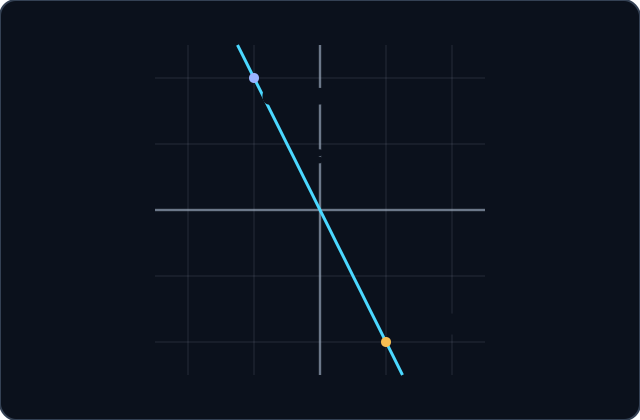
Hooke's law , drawn for with the displacement across and the force up. Stretched, the spring pulls back; compressed, it pushes out: the force always points towards equilibrium.
Newton, Hooke and friction
For a mass on a spring of stiffness , with friction coefficient and applied force , the displacement from equilibrium satisfies . Measuring from the equilibrium position removes gravity, because the spring's stretch there balances the weight. The natural frequency is how fast the system oscillates when left alone without friction.
Reading the equation
- Stiffer springs and lighter masses oscillate faster: .
Applications
Practice
Adding Up the Forces
Mass times acceleration equals the sum of the forces: the spring pulls back, friction resists motion, and the applied force pushes.
Try it
A kg mass on a spring of stiffness N/m, with friction coefficient N·s/m and no applied force, obeys which equation?
Try it
What is for a kg mass on a spring with N/m?
Try it
Measuring displacement from the equilibrium position removes gravity from the equation of a hanging spring.
The Same Equation in a Circuit
A resistor, an inductor and a capacitor in series obey the spring equation for the charge, term for term.
Try it
In the analogy between a spring and a series circuit, what plays the part of the mass?
Try it
A mass of kg oscillates without friction at . What is ?
Try it
With , the friction force always points against the velocity.
Try it
Doubling the mass on a spring, with nothing else changed, does what to the natural frequency?
Try it
A circuit has and and no resistance. What is its natural frequency ?
Final checkpoint
Try it
In , which term is the restoring force of the spring?
Try it
A mass on a spring obeying Hooke's law gives a linear equation with constant coefficients.
Try it
What is the natural frequency of ?
Completion
Lesson complete
Great work! You now know how to:
- build the spring equation from Newton’s and Hooke’s laws
- say what each coefficient means and compute the natural frequency
- explain why gravity drops out when measuring from equilibrium
- translate between a spring and a series circuit