Intuition
Add friction and the energy leaks away. Whether the characteristic roots are real or complex now depends on the square of the friction against four times the mass times the stiffness, and that comparison sorts the motion into three kinds: underdamped, which still oscillates while it decays; critically damped, the quickest return without oscillating; and overdamped, a slower creep back. All three die away.
A door with a closer. Too little damping and it swings past the frame and back; too much and it creeps shut; set just right, it closes quickly without swinging past. Critical damping is that setting.
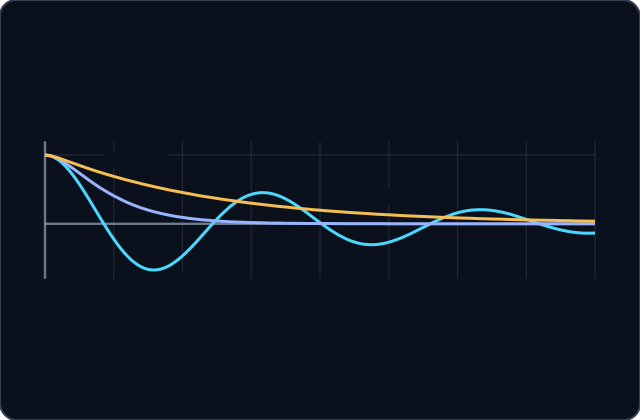
Released from at rest: is underdamped and oscillates as it decays; is critically damped and returns fastest without crossing; is overdamped and creeps back.
Three regimes, one discriminant
For with : if the motion is underdamped, with ; if it is critically damped, ; if it is overdamped, a combination of two decaying exponentials. In every case .
What each regime does
- Underdamped motion oscillates at : friction slows the oscillation as well as shrinking it.
- Critical damping, , is the boundary: the quickest return to rest without oscillating.
Damped motion always dies away
Read the sum and the product of the roots off the coefficients: the sum is minus c over m, negative, and the product is k over m, positive. A complex pair has twice its real part as its sum, so the real part is negative. Two real roots with a positive product share a sign, and their negative sum makes it negative. Either way every term of the solution decays, so the motion dies away.
Proof steps
The sum and product of the roots, read off the coefficients.
A complex pair sums to twice its real part, which is therefore negative.
Real roots with a positive product share a sign, and a negative sum makes it negative.
Every term of the solution decays, so the motion dies away.
Applications
Practice
One Discriminant, Three Regimes
Compare with : smaller oscillates, equal is critical, larger creeps.
Try it
Which kind of motion does describe?
Try it
For and , what friction coefficient gives critical damping?
Try it
With , and all positive, every solution of tends to zero.
Try it
How many times can an overdamped system cross its equilibrium position?
Try it
What is the damped frequency of ?
Try it
Friction makes an underdamped oscillator oscillate more slowly than it would without friction.
Try it
Along a solution of , what is the derivative of ?
Try it
The underdamped motion of lies inside . What is ?
Final checkpoint
Try it
A door closer is adjusted so the door shuts as quickly as possible without swinging past the frame. Which regime is that?
Try it
Increasing the damping beyond the critical value always makes the system return to rest faster.
Try it
What is for ?
Completion
Lesson complete
Great work! You now know how to:
- classify a damped oscillator from its coefficients
- find the damped frequency and the decay rate
- prove that damped motion always dies away
- say why critical damping is the fastest return without oscillation