Intuition
Push a damped spring with a force that swings back and forth like a cosine, and it ends up moving at the frequency of the push, not its own. Every solution is the particular solution plus a homogeneous one, and with friction the homogeneous part — the transient — dies away. What remains is the steady state, a cosine at the driving frequency, whose amplitude depends on how the driving frequency compares with the natural one.
A child on a swing pushed in a steady rhythm. Whatever the swing was doing when the pushing began is soon forgotten, and it ends up swinging in time with the pushes.
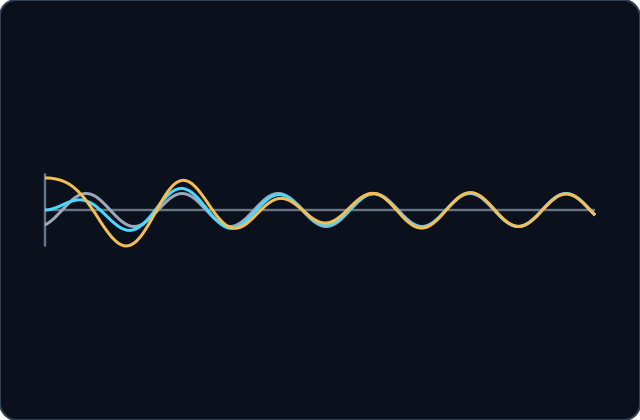
from two different starts. The transients differ and die away, and both motions settle onto the same steady state, at the driving frequency .
Transient and steady state
For with , the particular solution is with the amplitude below. Every solution is plus a homogeneous solution, which decays; so after the transient every motion is , whatever the initial conditions.
Reading the response
- The steady state has the driving frequency , not the natural one.
- The initial conditions affect only the transient, and the transient dies away.
- The amplitude is largest when is near and the damping is small; far from it the response is small.
Every forced motion approaches the same steady state
The difference between any solution and the particular solution solves the homogeneous equation, by linearity. With positive damping every homogeneous solution dies away, as the damping lesson proved. So the difference tends to zero: every motion, whatever its start, approaches the one particular motion.
Proof steps
The difference of two solutions solves the homogeneous equation.
With damping, every homogeneous solution dies away.
So the start is forgotten, and only the steady state remains.
Applications
Practice
It Moves at the Driving Frequency
After the transient, a damped system driven by a cosine moves as a cosine of the same frequency, with its own amplitude and phase.
Try it
A damped spring with natural frequency is driven by . At what frequency does it move in the long run?
Try it
With damping, the long-run motion of a forced spring does not depend on its initial conditions.
Try it
What is the steady-state amplitude for ?
Try it
At very low driving frequency, the steady amplitude of is close to what?
Try it
In the steady state, a forced damped oscillator moves at its natural frequency.
Try it
For , the particular solution is . What is ?
Try it
What is the transient in a forced damped oscillation?
Try it
Driven at a very high frequency, a mass on a spring barely moves.
Final checkpoint
Try it
What is the steady-state amplitude for ?
Try it
A mass driven far above its natural frequency moves how, relative to the force?
Try it
The difference between any two solutions of a forced damped oscillator tends to zero.
Completion
Lesson complete
Great work! You now know how to:
- split a forced damped motion into transient and steady state
- compute the steady amplitude from the driving frequency
- prove that every motion approaches the same steady state
- describe the response at low and high driving frequencies