Intuition
With no friction and no forcing the characteristic roots are purely imaginary, and the motion is a pure oscillation that never dies: a cosine at the natural frequency, shifted in time. Its amplitude is set by how the motion was started, and its period does not depend on the start at all.
A clock depends on its oscillator keeping the same period whether it swings wide or narrow. For a mass on a spring that is exactly true, and it is what makes an oscillator a clock.
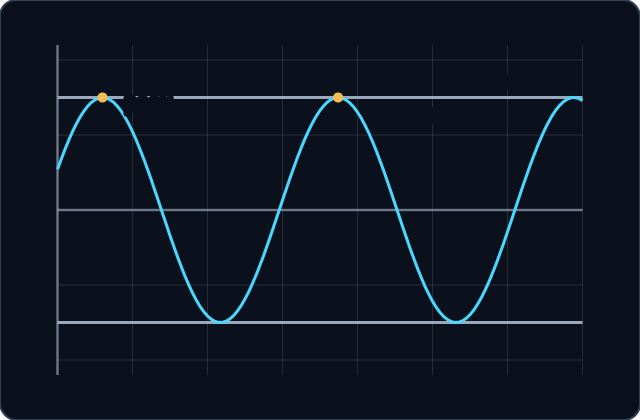
The free oscillation : its amplitude between the dashed lines, and successive peaks one period apart.
Amplitude, phase and period
The solution of with and is , with , amplitude and period . The energy stays constant.
What the numbers are
- Released from rest at : , with amplitude .
Without friction the energy is conserved
Differentiate the energy along a solution. The chain rule gives m times x prime times x double prime, plus k times x times x prime. Take x prime out: what is left in the bracket is the left-hand side of the equation, which is zero. So the energy never changes, and the oscillation can neither grow nor die.
Proof steps
The energy of the motion plus the energy stored in the spring.
Differentiate along the motion by the chain rule.
Take out the velocity.
The bracket is the left-hand side of the equation, which is zero along a solution.
Applications
Practice
Try it
What is the motion of released from rest at ?
Try it
What is the period of , to two decimal places?
Try it
The period of a frictionless mass on a spring depends on how far it is pulled before release.
Try it
For with and , what is the amplitude ?
Try it
Where is all the energy in the motion rather than in the spring, during a free oscillation?
Try it
Without friction or forcing, the amplitude of a mass on a spring stays the same for ever.
Try it
A mass obeying is struck at equilibrium, giving . What is its motion?
Try it
A frictionless oscillator has period . What is ?
Final checkpoint
Try it
Why is a pendulum only approximately a simple oscillator?
Try it
Along a solution of , the quantity is constant.
Try it
For , what is the largest speed the mass reaches?
Completion
Lesson complete
Great work! You now know how to:
- solve the free oscillation from its starting position and velocity
- find its amplitude, phase and period
- prove that its energy is conserved
- say why the period does not depend on the amplitude