Intuition
An ordinary equation asks for a number: solve it and you get 7. A differential equation asks for a function, and it asks for it in an unusual way — by saying how fast that function changes. It never tells you the value directly. It tells you the slope, and leaves you to reconstruct everything from that.
You are handed a map with no roads on it, only a compass reading written at every point: from here, go that way. Nothing tells you where you are going to end up. But put your finger anywhere on the map and start walking, always following the reading under your finger, and a single path unwinds. A differential equation is that map, and the path is the solution.
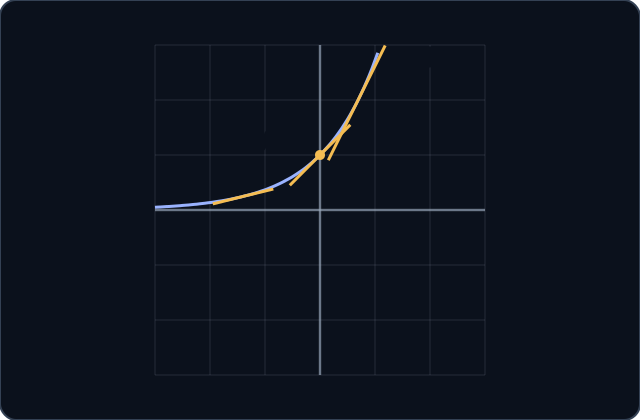
The curve solves . At every one of its points the tangent, drawn here at three of them, has exactly the steepness the height of the curve there: that is the whole content of the equation.
The equation, and what answers it
A differential equation relates an unknown function to its own derivatives. When the unknown depends on one variable it is an ordinary differential equation, an ODE; when it depends on several and partial derivatives appear it is a partial differential equation, a PDE, and those are a course of their own. A solution is a function, defined on an interval, that turns the equation into a true statement at every point of that interval.
What to notice
- The unknown is a function, not a number. "Solve " asks which functions have the property that differentiating them changes nothing.
- Checking a candidate needs no theory at all: differentiate it, substitute, and see whether the two sides agree. Every method in this course can be checked this way, and should be.
- is a differential equation whose answer is any antiderivative, . Most equations are not this easy, because the unknown appears on the right as well.
Applications
Practice
An Equation Whose Answer Is a Function
An ordinary equation is solved by a number. A differential equation is solved by a function, and what it tells you about that function is how fast it changes.
asks: which functions equal their own derivative?
Try it
In the equation , what is the unknown?
Ordinary or Partial
One independent variable and ordinary derivatives: an ODE. Several independent variables and partial derivatives: a PDE, which belongs to a later course.
- — one variable , so ordinary.
- — two variables and , so partial.
Try it
Which of these is a partial differential equation?
Checking Is Always Available
To test whether a function solves an equation, differentiate it and substitute. No method is needed, and this check is worth doing after every solution you find.
Try it
The function is a solution of .
Try it
Which function solves ?
Try it
For how many constants is the constant function a solution of ?
Try it
Which of these is not a differential equation?
A Solution Comes With an Interval
A solution has to make the equation true at every point where it is claimed to hold, so it is a function on an interval — and the interval is part of the answer.
Try it
A function can be a solution of a differential equation on an interval without being a solution on the whole real line.
Try it
At the point , what does the equation tell you about a solution through that point?
Try it
The equation has more than one solution.
Final checkpoint
Try it
Which function solves ?
Try it
For which value of is a solution of ?
Try it
An equation containing is an ordinary differential equation.
Completion
Lesson complete
Great work! You now know how to:
- say what a differential equation asks for, and why the answer is a function
- tell an ordinary equation from a partial one
- check any proposed solution by differentiating and substituting
- read the slope of a solution at a point straight off the equation