Intuition
The picture of a direction field suggests something that ought to be proved: put your finger anywhere and one curve unwinds. It is nearly true, and where it fails the failure is worth seeing. If the right-hand side is continuous, a solution exists near the point. If it is also smooth in the second variable, that solution is the only one. Neither condition promises the solution lasts for ever.
The compass reading has to vary smoothly for the walk to be forced. Where two roads split at a signpost with the same reading on both — which is what a right-hand side with a corner in it does — the walk is no longer determined, and more than one path leaves that point.
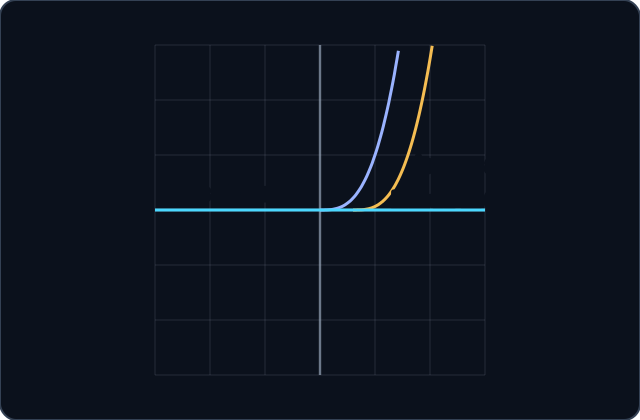
Three solutions of through the origin: stay at zero for ever, leave at once, or wait and leave later. The right-hand side is continuous but not smooth at , and uniqueness goes with the smoothness.
What is promised, and for how long
Picard–Lindelöf. If is continuous on a rectangle about and is continuous there too, then the initial value problem , has exactly one solution on some interval about . Continuity of alone gives existence; the condition on is what gives uniqueness. The proof builds the solution as the limit of successive approximations and belongs to a later course; this course uses the statement.
The two failures
- Uniqueness can fail. with has , and for every , and more besides. Here blows up at .
Solution curves cannot cross
Suppose two solutions of the same equation pass through one point, and suppose the equation satisfies the uniqueness condition everywhere. Then both are solutions of the same initial value problem at that point, and uniqueness says there is only one such solution — so the two functions agree near the point. Running the same argument at the edge of the region where they agree extends it, and they agree wherever both are defined. So two solution curves either coincide or never meet at all, which is exactly what the picture of a family of curves shows.
Proof steps
Suppose two solutions take the same value at the same point.
Then both solve one and the same initial value problem.
The uniqueness theorem applies at that point.
So the two functions are the same function near the point.
Repeating the argument at the edge of the agreement carries it as far as both exist: the curves coincide rather than cross.
Applications
Practice
Two Conditions, Two Promises
Continuity of the right-hand side gives a solution. Continuity of its derivative in y gives that there is only one.
Try it
Which condition of the theorem is the one that gives uniqueness?
Near the Point, Not for Ever
The theorem promises an interval about the starting point. How long that interval is, it does not say.
Try it
The existence theorem guarantees a solution on the whole real line.
Try it
For which problem does the uniqueness condition fail at the starting point?
Try it
Where the uniqueness condition holds everywhere, two different solution curves can touch at one point and separate afterwards.
Try it
The solution of with is . At which value of does it cease to exist?
Try it
Why does a linear equation with continuous and never have the uniqueness trouble?
Try it
The problem , has infinitely many solutions. What does that say about existence?
Try it
Continuity of the right-hand side alone is enough to guarantee that an initial value problem has exactly one solution.
Final checkpoint
Try it
To decide whether , has a unique solution near , where must the conditions be checked?
Try it
Why is the existence and uniqueness theorem stated in this course rather than proved?
Try it
Of the functions , and , how many solve with for ?
Completion
Lesson complete
Great work! You now know how to:
- state what the existence and uniqueness theorem promises, and what it does not
- name the condition that gives uniqueness, and an equation where it fails
- explain why a solution may exist only on a short interval
- argue that solution curves cannot cross where uniqueness holds