Intuition
Almost every differential equation in science arrives the same way: somebody says how fast something changes, in terms of how much of it there is. "Twice as much, twice as fast" is a proportionality and becomes one line of mathematics. Getting the model right is mostly getting the signs right, and the way to check a sign is to ask what the equation predicts when the quantity is large.
Translating a sentence into an equation is like translating between languages with different word orders: the individual words are easy and the mistake is always in the arrangement. "Cools at a rate proportional to the difference from the room" has to come out with a minus sign, or the coffee heats up.
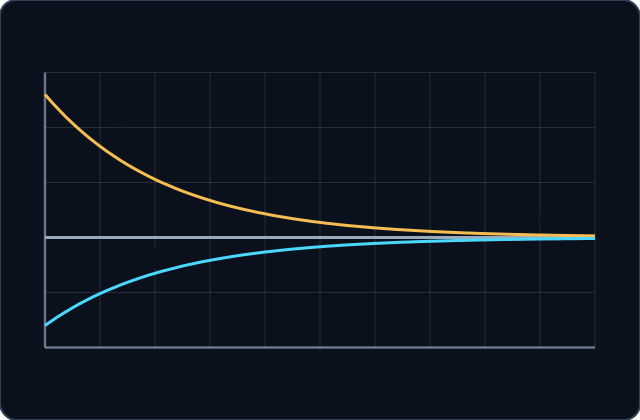
Newton's law of cooling, , from above and from below. Both approach the room temperature and neither reaches it; the sign of is what makes them approach rather than run away.
From a sentence to an equation
A model names a quantity, says what its rate of change is, and states the value at one moment. "The rate of change of is proportional to " is ; "proportional to the difference between and the surroundings , and always towards " is with . The constant is named, not chosen, and is fixed later by a measurement.
Building one, and checking it
- Proportional to means multiplied by a constant: . Inversely proportional to means divided by it: .
Applications
Practice
Proportional Means Times a Constant
A rate proportional to the amount is the amount multiplied by a constant. Which constant is a question for a measurement, not for the modelling.
Try it
A colony grows at a rate proportional to its size . Which equation says so?
Check a Sign by Making the Quantity Large
Put a large value into the right-hand side and ask whether the prediction is what the world does. A hot object must cool.
Try it
Newton's law of cooling for an object at in a room at , with . Which equation is right?
Try it
For a quantity with something flowing in and something flowing out, the model is rate in minus rate out.
Try it
Brine flows out of a well-stirred tank of constant volume at litres per minute. If is the salt in the tank, at what rate does salt leave?
Try it
For , at what speed does the acceleration vanish?
Try it
If a model predicts something the world does not do, the mathematics must contain an error.
Try it
"The rate of change of is inversely proportional to ." Which equation says that?
Try it
In with measured in bacteria and in hours, what are the units of ?
Final checkpoint
Try it
A drug leaves the blood at a rate proportional to the amount present, and is infused at a constant milligrams per hour. Which model is right?
Try it
The constant in a model such as is fixed by the modelling itself.
Try it
For , at what level does the quantity stop changing?
Completion
Lesson complete
Great work! You now know how to:
- turn a sentence about a rate into a differential equation
- check the sign of a model by asking what it predicts for a large value
- write a balance law as rate in minus rate out
- use units to catch a mistake before solving anything