Intuition
A first-order equation hands you the slope at every point of the plane without being solved. Draw a short mark of that slope at each point of a grid and the whole family of solutions appears as a texture: the curves are the paths that keep to the marks. Most equations cannot be solved in closed form, and for those this picture is not a preliminary — it is the answer.
Iron filings scattered round a magnet line up with the field and make its shape visible, although not one of them is a field line. The marks of a direction field do the same: each is a tangent to whichever solution passes through it, and the eye assembles them into curves.
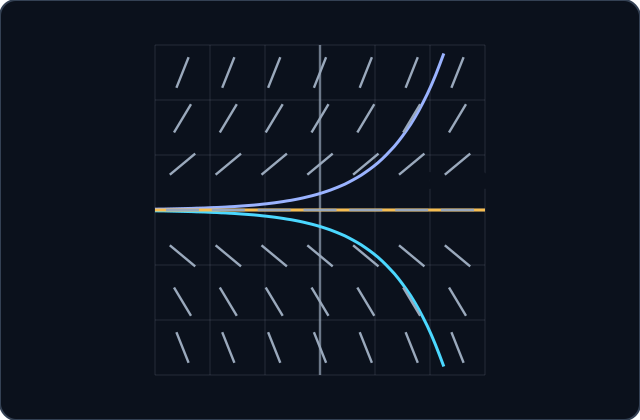
The field of : the mark at each point has the steepness of the height there, so it is flat on the axis and steepens away from it. Three solutions follow the marks.
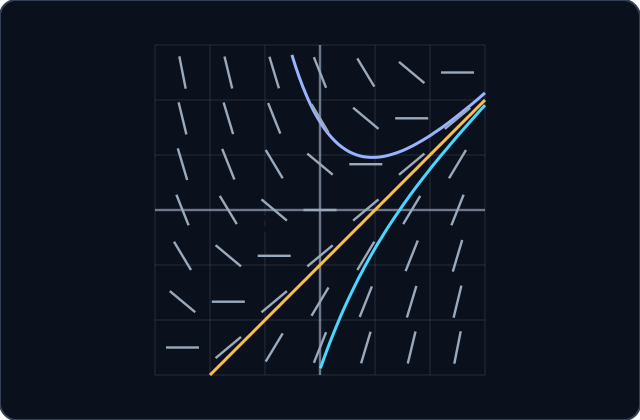
The field of . Every solution is drawn towards the line , which is itself a solution — and that can be read off the marks before any method is applied to the equation.
Building the field, and reading it
For , the direction field is the short mark of slope drawn at each point of a grid. A solution curve is a curve that is tangent to the mark at every point it passes through. The set where is an isocline: along it every mark has the same slope , and sketching a few isoclines is the quickest way to draw a field by hand.
What can be read without solving
- Where the marks are flat, so solutions have their maxima and minima there. This is the nullcline, the isocline for slope zero.
- If depends on alone the field is the same along every vertical line, and the solutions are horizontal shifts of one another.
- If depends on alone the field is the same along every horizontal line, and the solutions are vertical shifts of one another — which is why is answered by one integration.
Applications
Practice
A Mark Is a Tangent
At the point (x, y) the equation gives one number, the slope. The mark drawn there is a short piece of the tangent to whichever solution passes through.
Try it
For , what slope is drawn at the point ?
Flat Marks Are Where the Turning Points Are
Solutions have a maximum or a minimum only where their slope is zero, so the curve f(x, y) = 0 is where all the turning happens.
Try it
Where are the marks flat in the field of ?
Try it
A direction field can be drawn without solving the equation.
Try it
In the field of which equation do the marks along each horizontal line all have the same slope?
Try it
For , what slope is drawn at the point ?
A Flat Row of Marks Is a Constant Solution
If every mark along a horizontal line is flat, the horizontal line itself is a solution: it has slope zero everywhere, and so does the field along it.
Try it
If the marks of are flat all along the line , then is a solution.
Try it
In the field of , the marks are flat along , upward below it and downward above it. What happens to a solution starting at ?
Try it
What is the isocline of slope for the equation ?
Final checkpoint
Try it
Each mark of a direction field is a small piece of a solution curve.
Try it
For , how many horizontal lines carry only flat marks?
Try it
The field of has marks that are flat on the -axis and vertical on the -axis. Which family are its solutions?
Completion
Lesson complete
Great work! You now know how to:
- draw the mark of a direction field at any point, straight from the equation
- find the nullcline and use it to place the turning points of solutions
- read long-run behaviour off a field without solving anything
- recognise a constant solution as a row of flat marks