Intuition
Integrating once introduces one arbitrary constant, so a first-order equation does not have a solution — it has a whole family of them, one for each value of that constant. Drawn on the plane the family fills up the picture: a stack of curves that never touch, covering every point exactly once. Solving is finding the family; picking a member of it is a second step, and it needs a second piece of information.
Knowing your speed for the whole journey does not tell anyone where you are, because it never says where you started. Every possible starting point gives a different journey, and they are all consistent with the same speedometer reading. The constant of integration is the starting point that the equation never mentions.
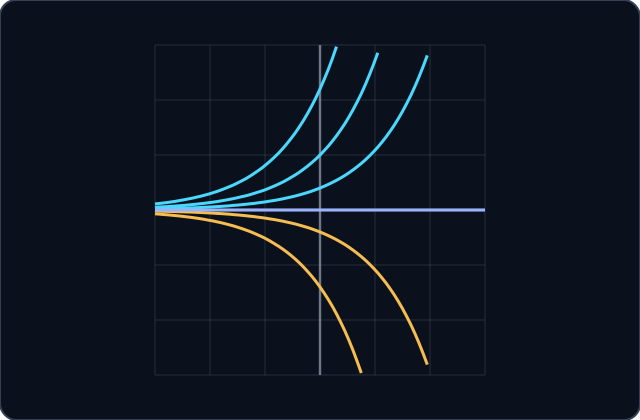
The family , which is every solution of . Positive above the axis, negative below, and the constant zero between them; no two curves of the family meet.
General, particular, explicit, implicit
The general solution of an equation is the family holding every solution, written with arbitrary constants — one for each order. A particular solution is one member of that family, with the constants fixed to numbers. A solution written as is explicit; one left as a relation that cannot be untangled is implicit, and is still a solution.
What a family is like
- An th-order equation has arbitrary constants in its general solution. gives , a two-parameter family.
Applications
Practice
One Constant for Each Order
Each integration introduces one arbitrary constant, so an equation of order n has a general solution with n of them.
Try it
How many arbitrary constants does the general solution of a third-order equation have?
Finding a Family by Integrating
When the right-hand side holds no y, the equation is answered by integration and the constant appears at once.
Try it
What is the general solution of ?
Try it
Writing as the general solution of is a complete answer.
A Solution Need Not Be Solved for y
A relation between x and y that implies the equation when differentiated is a solution, even when y cannot be separated out.
Try it
Why is left as it is rather than solved for ?
Try it
In the family , which value of gives the solution passing through ?
Try it
Two different curves of the family meet somewhere on the plane.
A Family Can Miss One
Some equations have a solution that no value of the constant produces. It is usually a constant function, and it is usually lost by dividing.
Try it
The family holds every solution of except one. Which?
Try it
Which is a particular solution of ?
Final checkpoint
Try it
Different members of one solution family can be defined on different intervals.
Try it
The general solution of is . Which is the member with and ?
Try it
Through the point , how many members of the family pass?
Completion
Lesson complete
Great work! You now know how to:
- say why a first-order equation has a family of solutions rather than one
- count the arbitrary constants an equation of given order must have
- recognise an implicit solution and say why it is not always worth untangling
- watch for the constant solution a family can miss