Intuition
An equation with a family of answers becomes a question with one answer as soon as a single measurement is added: the value of the solution at one point. Geometrically the condition names a point of the plane, and the answer is the one curve of the family through it. The order in which the work is done matters — find the family first, with its constant, and use the condition last.
The equation is the rule of the road and the initial condition is where the car is parked at noon. Neither alone tells you where the car will be at one o’clock; together they do, and there is nothing left to choose.
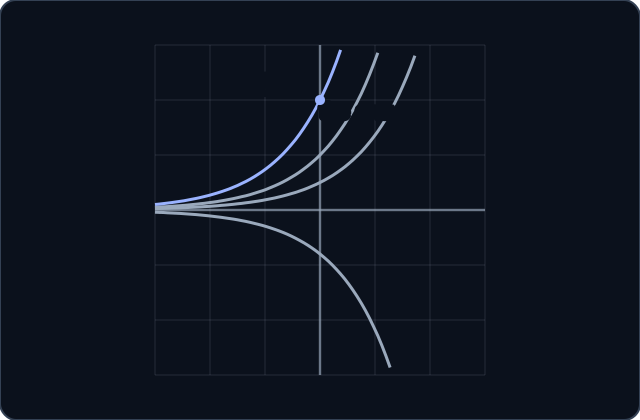
The family in grey, and the one member through in green. The condition does not change the equation; it chooses.
The problem, and what makes it one problem
An initial value problem is a differential equation together with enough conditions at a single point to fix every constant. A first-order equation needs one condition, ; an th-order equation needs , giving the value and the first derivatives at . The conditions are all imposed at the same point — conditions at two different points make a boundary value problem, which is a different subject.
How to do it, and what goes wrong
- Find the general solution first, keeping the constant, then substitute the condition. Imposing the condition part-way through is the mistake that produces an answer with no constant left to fix.
- For a second-order equation the two conditions are and : a position and a velocity, both at the same instant.
Applications
Practice
One Condition for Each Constant
The number of conditions needed matches the order, because that is how many constants there are to fix.
Try it
How many initial conditions does a second-order equation need to have a unique answer?
Family First, Condition Last
Solve the equation with its constant still in place. Only then substitute the condition and solve for the constant.
Try it
Solve with .
Try it
It is safe to use the initial condition before finding the general solution.
Try it
The general solution of is . What is if ?
Try it
Which pair of conditions makes an initial value problem?
Try it
Geometrically, what does the condition do?
Try it
The solution of with is . What is ?
Try it
Two initial value problems with the same equation and different conditions always have different solutions.
Final checkpoint
Try it
A student solves , and writes: ", so ; then , so there is no solution." Where is the mistake?
Try it
The general solution of is . Which member has and ?
Try it
Conditions given at two different points still make an initial value problem.
Completion
Lesson complete
Great work! You now know how to:
- count the conditions an equation of a given order needs
- solve a simple initial value problem in the right order: family first, condition last
- read an initial condition as a point the solution curve must pass through
- tell an initial value problem from a boundary value problem