Intuition
Some operators change states without destroying any information: every overlap between two states, and so every probability built from overlaps, comes out the same. They are called unitary, and they are how quantum systems change in time, how a polariser is turned, how a quantum gate acts. Undoing one is easy: its inverse is its adjoint.
A rigid rotation of a picture changes where everything is but no distance and no angle. Unitary operators are the rigid motions of state space, with complex phases allowed as well as turns.
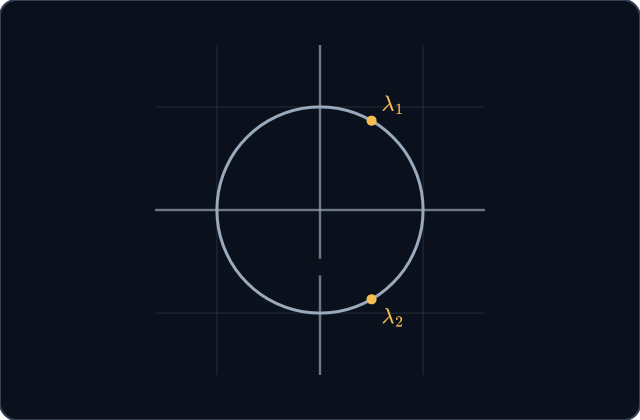
The eigenvalues of the rotation with are , drawn in the complex plane. Every eigenvalue of a unitary operator sits on the circle of modulus 1: it can change a phase, never a length.
Operators that keep every overlap
is unitary when its adjoint is its inverse. Then for every pair of states: lengths, angles and probabilities are all preserved. In an orthonormal basis the columns of its matrix form an orthonormal basis, and so do the rows.
What unitarity gives
- A unitary operator sends every orthonormal basis to an orthonormal basis, and any two orthonormal bases are related by one.
- Products and inverses of unitary operators are unitary; so is every phase .
- , since .
Eigenvalues of a unitary operator lie on the unit circle
Compute the squared length of in two ways. As it is times the squared length of ; because preserves lengths it is the squared length of itself. The two agree only if .
Proof steps
, and a number comes out of each side, once conjugated.
Move across the bracket and use .
Both are the same number.
Divide by : the eigenvalue is a pure phase .
Applications
Practice
Adjoint Equals Inverse
A matrix is unitary when its conjugate transpose times itself is the identity. Equivalently, its columns are orthonormal.
Try it
Which of these matrices is unitary?
Overlaps Are Kept
Because the adjoint undoes a unitary operator, the bracket of two transformed states equals the bracket of the originals. Every probability built from brackets is unchanged.
Try it
If is unitary, then for all states and .
On the Unit Circle
Every eigenvalue of a unitary operator has modulus one: the operator can turn a phase but cannot stretch.
Try it
The matrix is unitary. What is the modulus of each of its eigenvalues?
Orthonormal Columns
The columns of a unitary matrix are orthonormal. That can fix a missing entry: the bracket of the two columns must vanish, with the first one conjugated.
Try it
For which is unitary?
Try it
The product of two unitary operators is unitary.
Try it
A unitary matrix has determinant . What is ?
Try it
How is the inverse of a unitary operator obtained?
Final checkpoint
Try it
is both Hermitian and unitary.
Try it
What is the bracket of the first column of a unitary matrix with its third column?
Try it
Which of these does a unitary operator not always preserve?
Completion
Lesson complete
Great work! You now know how to:
- test a matrix for unitarity by its columns
- show that unitary operators keep every bracket
- prove that their eigenvalues are phases
- invert a unitary operator by taking its adjoint