Intuition
Most vectors come out of an operator pointing somewhere new. A few special ones come out along the same line, merely multiplied by a number. Those are the eigenvectors and the numbers are the eigenvalues. In quantum mechanics they will be the states in which a quantity has a definite value, and the values it can have.
Spin a globe about its axis. Every point on the surface moves, except the two poles, which stay on the line of the axis. The axis is an eigen-direction of the rotation, with eigenvalue one.
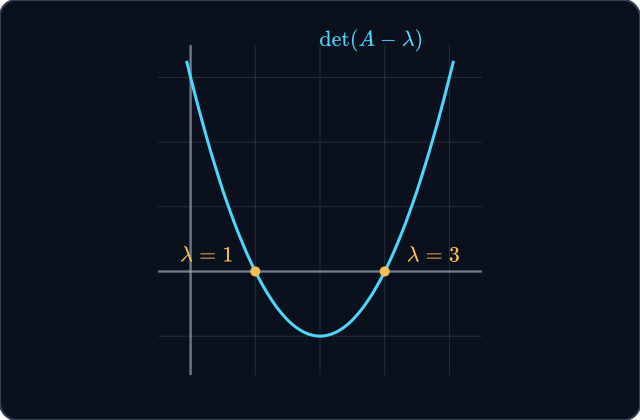
The characteristic polynomial of , , against . It crosses zero at the two eigenvalues, 1 and 3.
Eigenvalues and eigenvectors
A nonzero vector is an eigenvector of with eigenvalue when only multiplies it by . In a basis, the eigenvalues are the roots of the characteristic equation; each root is then put back to find its eigenvectors. An eigenvalue with more than one independent eigenvector is called degenerate.
How they behave
- Any nonzero multiple of an eigenvector is an eigenvector with the same eigenvalue, so an eigenvector is really a direction; in quantum mechanics it is normalised.
- For a matrix the characteristic equation is .
Trace and determinant from the eigenvalues
Expand the characteristic polynomial of a matrix and compare it with the same polynomial written through its two roots. The coefficient of is minus the sum of the roots and the constant term is their product. The same holds in any dimension, with the sum of all eigenvalues and their product.
Proof steps
Expand the determinant of for .
A monic quadratic is fixed by its two roots, the eigenvalues.
Multiply out the factored form.
Two polynomials that are equal have equal coefficients: the sum is the trace, the product the determinant.
Applications
Practice
Only Stretched, Not Turned
An eigenvector is a nonzero vector the operator does not turn: it comes out as a multiple of itself. The multiple is the eigenvalue.
Try it
. Which vector is an eigenvector of ?
The Characteristic Equation
The eigenvalues are the numbers for which has zero determinant. For a matrix that is a quadratic.
Try it
What is the larger eigenvalue of ?
Complex Entries, Real Roots
A matrix with complex entries can still have real eigenvalues. The recipe is the same: trace, determinant, quadratic.
Try it
What is the larger eigenvalue of ?
A Direction, Not a Vector
If is an eigenvector, so is every nonzero multiple of it, with the same eigenvalue. Normalising picks one representative.
Try it
If is an eigenvector of with eigenvalue , then is an eigenvector of with eigenvalue .
Try it
What is the product of the eigenvalues of ?
Try it
Every complex matrix has two linearly independent eigenvectors.
Try it
The matrix has which degenerate eigenvalue?
Final checkpoint
Try it
A matrix has diagonal entries and assorted entries off the diagonal. What is the sum of its three eigenvalues?
Try it
Every square matrix with complex entries has at least one eigenvalue.
Try it
Which are the eigenvectors of ?
Completion
Lesson complete
Great work! You now know how to:
- find eigenvalues from the characteristic equation
- find the eigenvectors that go with them
- use the trace and determinant as the sum and product of eigenvalues
- recognise a degenerate eigenvalue, and a matrix with too few eigenvectors