Intuition
A projector keeps the part of a state that lies in a chosen subspace and throws the rest away. Applying it twice does nothing more than applying it once. The ket-bra of a normalised state is the simplest example, and projectors are how the next chapter will say what a measurement does to a state.
The shadow of a stick on the floor is its projection. The shadow of the shadow is the same shadow, and a stick lying on the floor already is its own shadow.
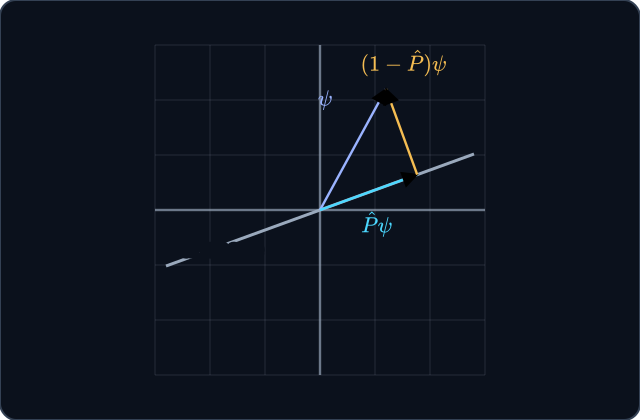
The projector onto the dashed line keeps the part of along it; keeps the part at right angles. The two parts add up to , and projecting again changes nothing.
Operators that keep a part
An operator is an orthogonal projector when and . The projector onto the subspace spanned by orthonormal vectors is the sum of their ket-bras; is then the projector onto everything orthogonal to that subspace.
Properties
- For a normalised state, projects onto the line through : it sends to .
A projector has eigenvalues 0 and 1
Apply the projector twice to an eigenvector. Once gives times the vector, twice gives times it, and since projecting twice is the same as projecting once the two agree. A number equal to its own square is 0 or 1: a vector is either kept whole or removed entirely.
Proof steps
An eigenvector, so .
Apply again and use linearity.
But .
Since , the number must vanish.
Applications
Practice
The Kept Part
The squared length of what a projector keeps is the bracket of the state with the projector acting on it. For the ket-bra of a basis state, that is the modulus squared of one coefficient.
Try it
With and , what is ?
Idempotent and Hermitian
An orthogonal projector squares to itself and equals its own adjoint. The ket-bra of a normalised state always qualifies.
Try it
Which of these is a projector?
Adding Projectors
Projectors onto orthogonal subspaces add up to the projector onto the whole of both. The completeness relation is the extreme case: the projectors onto all the basis states add to the identity.
Try it
If and project onto orthogonal subspaces, then is a projector.
Trace Is Dimension
In a basis adapted to the subspace a projector is diagonal with ones for the kept directions and zeros for the rest, so its trace counts the kept dimensions.
Try it
A projector on keeps a subspace of dimension 2. What is its trace?
Try it
The matrix of in the basis has entries , named as shown. Press the entry that equals 1.
Try it
Every projector is invertible.
Try it
with acts on . What is the squared length of the result?
Final checkpoint
Try it
projects onto a subspace. What does do?
Try it
Applying a projector twice to a state gives the same result as applying it once.
Try it
What is for any state, the bracket of the product ?
Completion
Lesson complete
Great work! You now know how to:
- recognise a projector by squaring it
- compute the kept part and its squared length
- prove that a projector’s eigenvalues are 0 and 1
- use the complementary projector