Intuition
Anything that can be done to a quantum state while respecting superposition — turning a polarisation, letting time pass, applying a gate in a quantum computer — is a linear operator. It sends states to states, and what it does to a sum is the sum of what it does to each part. Choose a basis and the operator becomes a matrix.
A linear operator is a kitchen machine that treats every ingredient separately and then combines the results. To know what it does to any dish, it is enough to know what it does to each ingredient — and that list is its matrix.
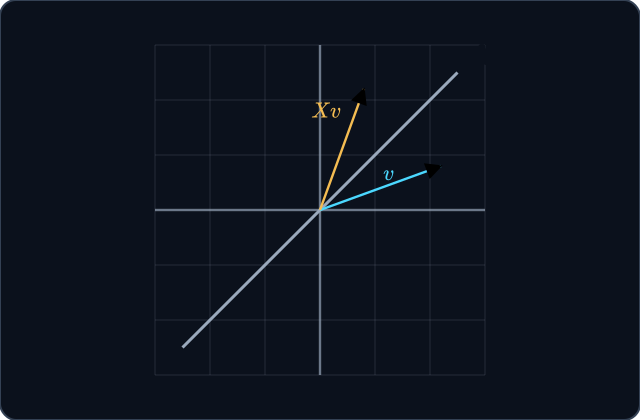
The operator swaps the two components of a vector, which in the plane is the reflection in the dashed line. It is linear: the reflection of a sum is the sum of the reflections. In the polarisation language of the last chapter it turns into and back.
Operators and their matrices
A linear operator assigns to every ket a ket, respecting superposition. In an orthonormal basis it is fixed by the numbers , its matrix elements, which form its matrix: the -th column holds the components of .
Working with operators
- A product means apply first, then ; its matrix is the product of the matrices in that order.
An operator is its matrix elements
Put the identity on both sides of the operator and write each identity with the completeness relation. What stands between each bra and ket is then a number, the matrix element, and the operator is spelled out as a sum of ket-bras weighted by its matrix elements.
Proof steps
Multiplying by the identity on either side changes nothing.
The completeness relation of the orthonormal basis.
Replace both identities by their sums.
What stands between and is a single number, which can be moved to the front.
So the matrix elements determine the operator completely.
Applications
Practice
Linear Means Respecting Sums
An operator is linear when the image of a combination of kets is the same combination of their images. Multiplying by a fixed matrix always is.
Try it
Which of these maps on the states of a qubit is a linear operator?
Matrix Elements
The matrix element in row and column is the bracket of the -th basis bra with the operator acting on the -th basis ket.
Try it
The matrix of in the basis is shown. Press the entry .
Acting on a State
To apply an operator to a state, multiply its matrix by the column of the state’s components. The flip exchanges the two components.
Try it
acts on the state with components . What is the second component of the result?
Ket-Bras Act on Kets
A ket followed by a bra is an operator. Acting on a ket, it makes the bracket of its bra with that ket and puts the answer in front of its own ket.
Try it
What does the operator do to and to ?
Try it
For any two operators, .
Try it
With and , what is the entry in row 1, column 2 of the product ?
Try it
In , which operator acts on first?
Final checkpoint
Try it
The matrix of an operator depends on the basis it is written in, while the operator itself does not.
Try it
For , what is ?
Try it
In an orthonormal basis , what does the -th column of the matrix of hold?
Completion
Lesson complete
Great work! You now know how to:
- test a map for linearity
- read a matrix element as the bracket of a basis bra with the operator on a basis ket
- multiply operators in the right order, and see that the order matters
- act with a ket-bra on a ket