Intuition
Turning a page and then flipping the book over is not the same as flipping it and then turning the page. Operators are like that, and the commutator — one order minus the other — measures by how much. It will decide which quantities can have sharp values together, and in the form position times momentum minus momentum times position it carries the whole of quantum mechanics’ break with classical physics.
Putting on socks and then shoes works; shoes and then socks does not. The commutator of two operations is the difference between the two outcomes, and zero means the order never matters.
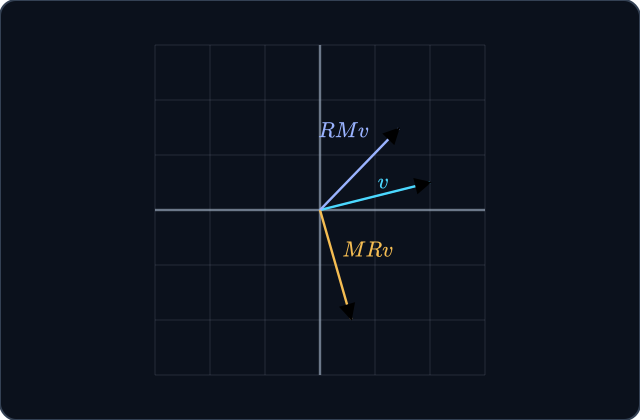
turns a vector anticlockwise and reflects it in the horizontal axis. Turning first and then reflecting sends to , below the axis; reflecting first sends it to , above it. The commutator is far from zero.
The commutator
The commutator of two operators is the difference of their products in the two orders. Two operators commute when it vanishes. It is antisymmetric, linear in each slot, and obeys a product rule that makes it behave like a derivative.
Identities used throughout the course
- and ; every operator commutes with and with any function of itself.
The product rule for commutators
Write out the commutator, add and subtract the one term that lets each group factor, and read off the two commutators. It is the same trick that proves the product rule for derivatives, and the commutator with a fixed operator is in fact a kind of derivative.
Proof steps
The definition, with in the second slot.
Add and subtract , which changes nothing.
Group the first two terms and the last two.
Each bracket is a commutator.
Applications
Practice
One Order Minus the Other
The commutator subtracts the product in the second order from the product in the first. It is zero exactly when the order never matters.
Try it
With and , what is the entry in row 2 and column 1 of ?
Swapping Changes the Sign
Swapping the two operators in a commutator swaps the two products, so the commutator changes sign.
Try it
for every operator .
A Product Rule
A commutator with a product splits into two terms, each with one commutator, exactly as the derivative of a product does.
Try it
If for a number , what is ?
Hermitian Pairs Give Anti-Hermitian Commutators
The adjoint of a commutator of two Hermitian operators is the commutator in the other order, which is minus the original.
Try it
The commutator of two Hermitian operators is Hermitian.
Try it
What is the trace of the commutator of any two matrices?
Try it
If , then .
Try it
For and , which is true?
Final checkpoint
Try it
For any three operators, .
Try it
If , what number multiplies in ?
Try it
Which operator certainly commutes with a given operator ?
Completion
Lesson complete
Great work! You now know how to:
- compute a commutator of two matrices
- use antisymmetry, linearity and the product rule
- show that the commutator of Hermitian operators is anti-Hermitian
- explain why a commutator of finite matrices has trace zero