Intuition
On a line, finding the stationary states means solving one ordinary differential equation for each energy. Where the energy is above the potential the solution wiggles, like a wave; where it is below, the solution curves away from the axis and must die off exponentially. That single fact decides everything that follows: which energies are allowed, why bound states come in a discrete ladder, and how particles leak into places classical mechanics forbids.
A ball rolling in a valley turns back where its energy equals the height of the slope. A quantum particle does not turn back so sharply: its wavefunction slips a little way past the turning point, fading as it goes, before it gives up.
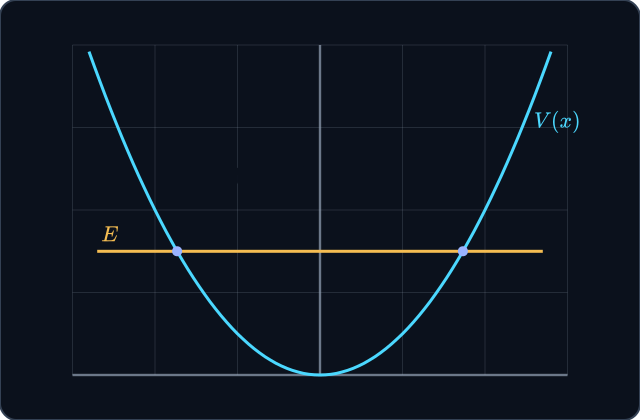
A potential and an energy . Between the turning points, where , the region is classically allowed and a solution oscillates; outside them , the region is classically forbidden, and a solution grows or decays exponentially.
The equation for stationary states
For a particle on a line the time-independent Schrödinger equation is a second-order linear ordinary differential equation. Its character at each point depends on the sign of , and the conditions at infinity decide which energies have acceptable solutions.
Reading the equation
- Where it reads with : the solution curves back towards the axis and oscillates.
Every energy lies above the bottom of the potential
Take the expectation value of the Hamiltonian in the eigenstate itself. The kinetic part, after an integration by parts, is an integral of and so positive, and the potential part is at least because integrates to one.
Proof steps
In an eigenstate the energy is its own expectation value.
Integrate by parts; the boundary term vanishes for a normalisable state.
An integral of is positive, since a normalisable cannot be constant.
Replace by its minimum under an integral with weight one.
Add the two.
Applications
Practice
Allowed Means Oscillating
Where the energy exceeds the potential, the equation says the second derivative has the opposite sign to the wavefunction, so it curves back towards the axis and oscillates.
Try it
In a region where , what does a solution of the time-independent Schrödinger equation do?
Forbidden Means Exponential
Where the potential exceeds the energy, the second derivative has the same sign as the wavefunction: it curves away from the axis and grows or decays exponentially.
Try it
Far to the right of a bound state's well, where , which solution is allowed?
Above the Bottom
The kinetic energy of any normalisable state is positive, so every energy eigenvalue lies strictly above the lowest point of the potential.
Try it
A potential with minimum value eV can have a bound state at eV.
Bound and Scattering States
States with energy below the potential at both infinities are bound: normalisable, with discrete energies. States with energy above the potential at infinity are scattering states: not normalisable, with a continuum of energies.
Try it
A potential tends to 0 at both infinities and dips to eV in between. Which energies can a bound state have?
Try it
In units with , what is the local wavenumber where ?
Try it
A scattering state of a potential that vanishes at infinity is normalisable.
Try it
In units with , a wavefunction decays as in a region with . Over what distance does it fall by a factor ? Give three decimal places.
Final checkpoint
Try it
At a point where and , what is the sign of ?
Try it
A stationary state has eV and eV. What is , in eV?
Try it
At a classical turning point the wavefunction must vanish.
Completion
Lesson complete
Great work! You now know how to:
- write the time-independent Schrödinger equation on a line
- tell oscillating from exponential behaviour by the sign of
- distinguish bound from scattering states
- prove that every energy lies above the bottom of the potential