Intuition
Make the step a barrier of finite width and something classically impossible happens: a particle without the energy to climb the barrier sometimes appears on the far side. Inside the barrier the wavefunction decays but does not vanish, and whatever is left at the far wall carries on as a wave. The chance falls off exponentially with the width and with the square root of the energy deficit — so steeply that it decides the rates of nuclear decay and the current in a tunnelling microscope.
Sound gets through a wall not by climbing over it but by being weakened as it passes through. A thicker wall weakens it far more: each extra layer multiplies the loss.
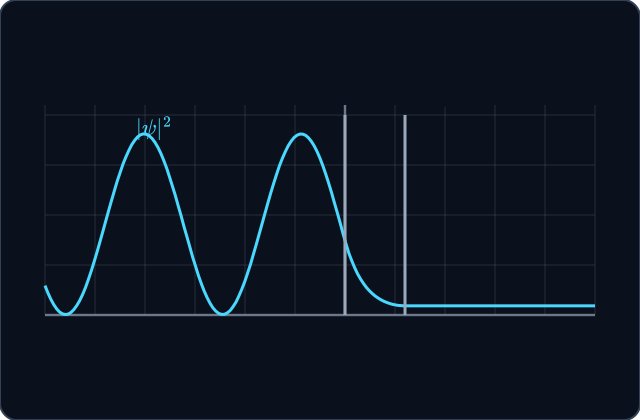
The exact probability density for a particle of energy meeting a barrier of height and width , between the dashed lines, in units with . On the left the incoming and reflected waves interfere; inside, the density decays; on the right a steady transmitted wave carries about a fifth of the current on.
Transmission through a barrier
For a rectangular barrier of height and width and energy , matching at both edges gives an exact transmission probability. For a thick barrier, , it is dominated by an exponential in the width.
How tunnelling behaves
- : a heavier particle or a larger deficit makes larger.
Why the thick-barrier transmission is exponential
For a thick barrier the hyperbolic sine is dominated by its growing exponential, which makes the second term of the bracket enormous. The inverse of one plus a huge number is its reciprocal, which is the prefactor times .
Proof steps
For the decaying exponential is negligible.
The second term of the bracket is huge.
One is negligible beside it.
Invert the approximated term.
Applications
Practice
Through, Not Over
A particle with less energy than a barrier can still appear on the far side, because its wavefunction decays inside the barrier without vanishing.
Try it
A particle with less energy than the top of a barrier of finite width meets it. What can happen?
Exponential in the Width
For a thick barrier the transmission is dominated by . Each extra thickness multiplies by the same factor.
Try it
A barrier has per nm. By what factor does fall when the barrier is made 0.1 nm thicker? Give two decimal places.
The Thick-Barrier Estimate
For , is about .
Try it
With and , what does the thick-barrier estimate give for ? Give three decimal places.
Heavier Tunnels Less
grows as the square root of the mass, so a heavier particle meets an exponentially stronger suppression.
Try it
A proton tunnels through a given barrier as easily as an electron with the same energy.
Try it
Which change reduces tunnelling through a thick barrier the most?
Try it
For an electron per nm times with the deficit in eV. What is , in per nm, for a deficit of 4 eV? Give one decimal place.
Try it
For a thick barrier most of the incoming probability is reflected.
Final checkpoint
Try it
What does the wavefunction do inside a barrier, where ?
Try it
A barrier transmits . What is ?
Try it
A particle can be caught inside a barrier with negative kinetic energy.
Completion
Lesson complete
Great work! You now know how to:
- explain tunnelling through a barrier
- estimate transmission through a thick barrier
- judge how width, height and mass change the rate