Intuition
A potential built from pieces — steps, walls, wells — is solved piece by piece, and the pieces must be joined. The joining rules come from the equation itself: the wavefunction is always continuous, its slope is continuous wherever the potential is finite, it vanishes at an infinite wall, and at a delta-function spike its slope jumps by an amount proportional to the value there.
A rope tied to a wall cannot move at the wall; a rope passing a smooth post keeps both its position and its slope; a rope pulled sharply at one point by a hook bends there in a corner. Each rule for the wavefunction is one of these.
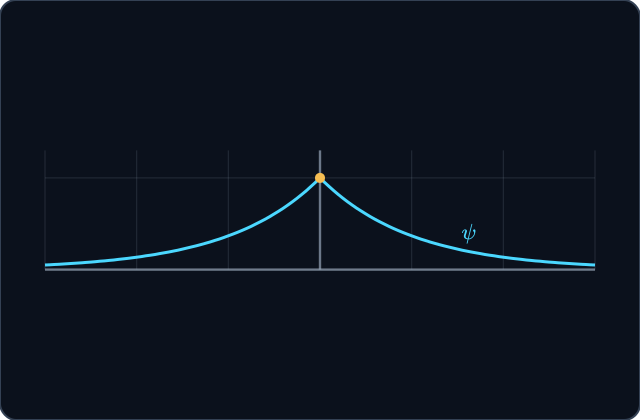
The wavefunction of a delta-function well: continuous everywhere, with a corner at the origin where the delta sits. The slope jumps from to , by an amount fixed by the strength of the delta.
Matching conditions
Integrating the Schrödinger equation across a point shows how the wavefunction and its derivative may behave there. Where the potential is finite, both are continuous; where it has a delta function the derivative jumps; where it is infinite the wavefunction vanishes.
The rules
- is continuous everywhere: a jump in would make contain the derivative of a delta function, which nothing in the equation can balance.
- is continuous where is finite, even at a step: the integral over a vanishing interval is zero.
The jump at a delta function
Integrate the Schrödinger equation over a short interval around the origin and let it shrink. The second derivative integrates to the jump in the first derivative; the energy term vanishes with the interval's width; the delta function survives and picks out .
Proof steps
Integrate each term of the equation over .
The derivative integrates to a difference, the delta picks out the value at 0.
A bounded function integrated over a vanishing interval gives zero.
Rearrange: the slope jumps by an amount proportional to the value.
Applications
Practice
Always Continuous
The wavefunction itself is continuous at every point, whatever the potential does: a jump would make its second derivative too singular to balance.
Try it
At a finite potential step, which quantities must be continuous?
The Kink at a Delta
At a delta-function potential of strength , the slope of the wavefunction jumps by times the value there.
Try it
In units with , a potential acts on a wavefunction with . By how much does jump across the origin?
At an Infinite Wall
The wavefunction cannot enter where the potential is infinite, so it vanishes at an infinite wall. Its slope may be anything there.
Try it
What condition holds at an infinitely high wall?
Slopes at a Step
At a finite step the integral of the potential over a shrinking interval goes to zero, so the slope has no jump.
Try it
At a finite potential step, jumps by an amount proportional to the height of the step.
Try it
For an attractive delta well, with , and , how does the slope change across the origin?
Try it
. What is ?
Try it
A wavefunction can jump at a point where the potential has a finite step.
Final checkpoint
Try it
What makes the energies of bound states discrete?
Try it
In units with , a wavefunction has slope 2 just left of a delta potential and slope just right of it, with . What is the strength of ?
Try it
At an infinitely high wall the slope of the wavefunction may jump.
Completion
Lesson complete
Great work! You now know how to:
- state the matching conditions at steps, walls and delta functions
- derive the jump in slope at a delta function
- explain what makes bound-state energies discrete