Intuition
Bound states on a line have two tidy properties. No two of them share an energy — the Wronskian of the Differential Equations course proves it. And if the potential is the same on both sides of a point, every bound state is either even or odd about it. Add the node theorem, that the -th state crosses zero times, and the whole ladder of states can be sketched before a single equation is solved.
A symmetric bridge vibrates either symmetrically, both halves rising together, or antisymmetrically, one half rising while the other falls. Its modes, from the lowest up, add one more crossing point each time.
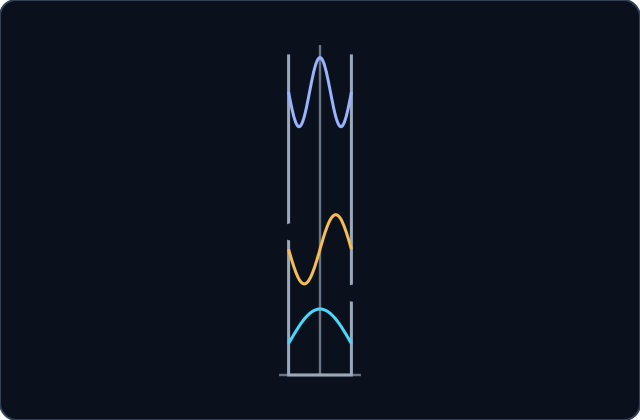
The first three states of a well symmetric about its centre, on their levels. They alternate even, odd, even, and each has one more node than the one below it: 0, 1, 2.
Two theorems about one-dimensional bound states
In one dimension a bound-state energy belongs to only one state, up to a factor. When the potential is even, , the mirror image of a bound state is a bound state of the same energy, so it can only be the same state times : every bound state is even or odd.
Consequences
- The node theorem: the bound states can be ordered by energy so that the -th has exactly nodes. It is stated here without proof — the proof belongs to Sturm–Liouville theory, beyond this course — and every solved example bears it out.
- In a symmetric well the ground state is even and the states alternate even, odd, even, …
- An odd state vanishes at the centre, so it does not feel a delta function placed there.
- Degeneracy in one dimension is possible only for states that are not normalisable, such as the two free waves of equal energy.
Bound states on a line are not degenerate
The Wronskian of two solutions with the same energy has zero derivative, by the equation itself, so it is constant along the line. For bound states both functions vanish at infinity, so the constant is zero, and a zero Wronskian means one solution is a multiple of the other.
Proof steps
The Wronskian of the two solutions.
Differentiate; the terms cancel.
Both obey the same equation with the same , so the two terms are equal.
A constant that tends to zero at infinity, where bound states and their slopes vanish, is zero.
Where the ratio is constant, and by continuity everywhere.
Applications
Practice
No Sharing on a Line
Two bound states of a one-dimensional potential never share an energy. Their Wronskian is constant and vanishes at infinity, so one is a multiple of the other.
Try it
Can two different bound states of a one-dimensional potential have the same energy?
The Node Theorem
Ordered by energy, the -th bound state of a potential on a line has exactly nodes.
Try it
How many nodes does the fifth bound state of a one-dimensional well have?
Even or Odd
In a potential symmetric about a point, every bound state is either even or odd about that point. The ground state, with no node, must be even.
Try it
In a potential symmetric about the origin, what is the parity of the ground state?
The Exception
Non-normalisable states can share an energy: the two free plane waves travelling in opposite directions have the same energy. The theorem needs the states to vanish at infinity.
Try it
and are two different solutions of the free equation with the same energy.
Try it
What is the Wronskian of and with ? Give the imaginary part.
Try it
An odd state of a symmetric well is unaffected by adding a delta function at the centre.
Try it
What are the parity and number of nodes of the third bound state of a symmetric well?
Final checkpoint
Try it
The non-degeneracy of bound states holds in three dimensions as well as in one.
Try it
A symmetric well has 7 bound states. How many of them are odd?
Try it
Why is the Wronskian of two solutions with the same energy constant?
Completion
Lesson complete
Great work! You now know how to:
- prove that one-dimensional bound states are not degenerate
- use parity to classify states of a symmetric well
- count nodes along the ladder of states