Intuition
Make the walls of the box finite and the wavefunction no longer stops dead at them: it seeps into the walls and decays there. The energies come out a little lower than in the infinite box, there are only finitely many bound states, and however shallow the well there is always at least one. Finding them means solving an equation that has no closed form, so it is solved by drawing two curves and reading off where they cross.
A plucked string fixed loosely at its ends, able to move a little at the pegs, vibrates slightly lower than one clamped hard: the loose ends let each shape stretch a little further.
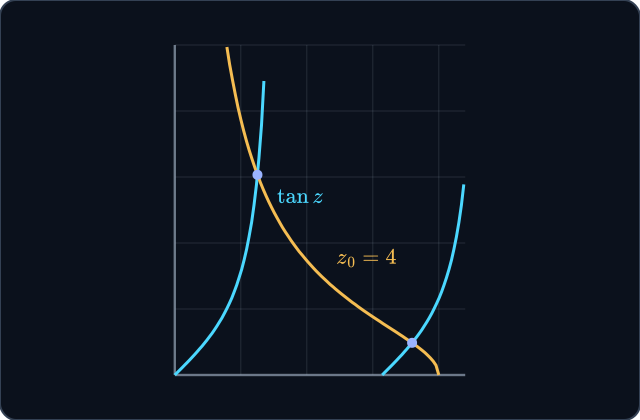
The even states of a finite well with : the solutions of with . The curves cross twice, at the dots, so this well has two even bound states; with one odd state between them it has three in all.
Bound states of a finite well
Take for and outside. A bound state has : it oscillates inside with wavenumber and decays outside with rate . Matching the logarithmic derivative at gives one transcendental equation for the even states and one for the odd states.
What the equations give
- In the variables and the even condition is .
The even-state condition
Match the wavefunction and its derivative at the edge , where the potential is finite. Dividing the two matching equations eliminates the unknown amplitude and leaves one equation between and — equality of the logarithmic derivatives on the two sides.
Proof steps
is continuous at .
is continuous at , since the step is finite.
Divide the second by the first: drops out.
Both come from the same energy: and .
Applications
Practice
Always at Least One
A one-dimensional attractive well, however shallow or narrow, always has at least one bound state: the two curves of the even condition always cross once.
Try it
How many bound states does a very shallow, narrow finite well have?
Counting States
The number of bound states of a finite well is the smallest whole number that is at least .
Try it
A finite well has . How many bound states does it have?
Leaking Lowers the Energy
Letting the wavefunction spread into the walls lets it bend less sharply, which lowers its kinetic energy compared with the infinite well of the same width.
Try it
Each bound level of a finite well lies higher, measured from the bottom of the well, than the matching level of an infinite well of the same width.
Inside the Walls
Outside a finite well the bound wavefunction decays as at a distance . The particle has a small probability of being found in the classically forbidden region.
Try it
Where can a particle in a bound state of a finite well be found?
Try it
In units with , a bound state has inside a well with . What is ?
Try it
As the depth of a finite well grows without limit, its lowest levels approach those of an infinite well of the same width.
Try it
Above what value of does a finite well acquire its first odd bound state? Give three decimal places.
Final checkpoint
Try it
Why is the finite well solved graphically?
Try it
A finite well has . How many bound states does it have?
Try it
Every bound state of a symmetric finite well is either even or odd.
Completion
Lesson complete
Great work! You now know how to:
- set up the finite well and match at its edges
- solve the quantisation condition graphically
- count bound states from and explain penetration into the walls