Intuition
Two states that matter and a coupling between them: a molecule of ammonia with its nitrogen above or below, an electron in a double well, an atom with two levels, a superconducting qubit. The Hamiltonian is a Hermitian two-by-two matrix, and up to a constant it is always : a bias that makes one state lower than the other, and a coupling that lets the system pass between them. The energies are , and the eigenstates are superpositions set by one angle, . With no bias the eigenstates are the equal mixtures; with a large bias they are close to the two states themselves.
Two identical pendulums joined by a weak spring swing together or against each other; make one heavier and each normal mode is mostly one pendulum. Bias and coupling play the same roles for two quantum states.
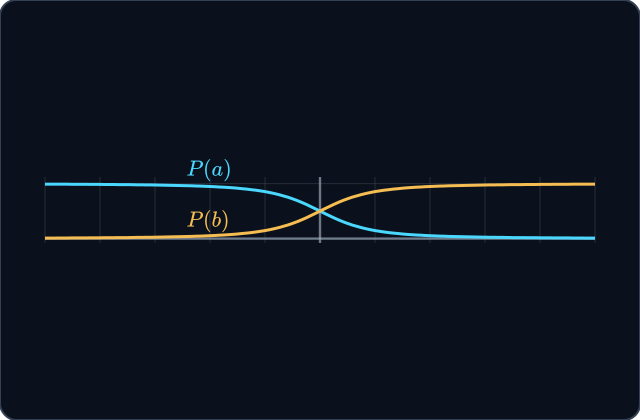
The weights of and in the ground state of , against the bias . With a large negative bias the ground state is nearly , with a large positive bias nearly , and at it is an equal mixture.
Two-level Hamiltonians
In a basis , with the constant part dropped, every two-level Hamiltonian with real couplings can be written
Properties
- is the bias, the energy difference of and without coupling; is the coupling, which lets the system pass between them.
- The eigenstates are and , with the mixing angle .
Energies and states of a two-level Hamiltonian
Square the Hamiltonian: the Pauli matrices square to one and anticommute, so the square is a number times the identity. The Hamiltonian has zero trace, so its two eigenvalues are opposite, and their square is that number. Writing the field as a length times a direction in the – plane gives the eigenstates as spin up and down along it.
Proof steps
and .
The trace is zero, so the eigenvalues are opposite; each squares to .
A length times a unit direction in the – plane.
Spin up and down along that direction, as in the spin chapter.
Applications
Practice
The Energies
A bias and a coupling give two levels at plus and minus half of .
Try it
A two-level system has bias and coupling , in some unit of energy. What is its upper energy?
No Bias
Without a bias the two states have equal energies, and the coupling mixes them evenly: the eigenstates are the sum and the difference.
Try it
With , what are the eigenstates?
Large Bias
When the bias is much larger than the coupling, the mixing angle is small and each eigenstate is almost one of the two states.
Try it
With a bias much larger than the coupling, the eigenstates are nearly equal mixtures of and .
Weights in the Ground State
In the ground state the weight of is , which is .
Try it
With and , what is the weight of in the ground state?
Try it
To which spin problem is the same?
Try it
The two levels of ammonia are eV apart. With eV s, what is the frequency of the line, in GHz? Give one decimal place.
Try it
Adding a constant to a two-level Hamiltonian changes its eigenstates.
Final checkpoint
Try it
What is the gap between the two levels of ?
Try it
For , the mixing angle is .
Try it
Without any coupling, , what are the eigenstates?
Completion
Lesson complete
Great work! You now know how to:
- write any two-level Hamiltonian as a bias and a coupling
- find its energies and its mixing angle
- read the eigenstates from the angle