Intuition
Change the bias slowly from large negative to large positive. Without coupling the two levels are straight lines that cross at . With a coupling they do not cross: the levels bend away from each other and keep a gap of at least , the smallest at . The eigenstates swap character across the gap: the lower level is on one side and on the other. For a system with one knob, coupled levels of the same symmetry avoid crossing each other; a true crossing needs the coupling to vanish, which symmetry can force or a second knob can tune.
Two roads approaching each other on a map, joined by a short bridge, do not cross but swap lanes: a car keeping to the lower road ends up on what began as the other road. Coupled levels meet the same way at an avoided crossing.
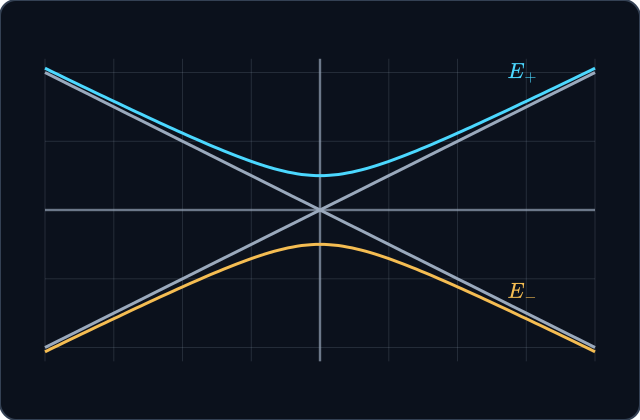
The two levels of against the bias , with . Without coupling they would be the dashed lines, crossing at ; with it they avoid each other, and the gap is never less than .
Avoided crossings
As the bias is varied at fixed coupling :
Properties
- Far from the crossing, , the levels are close to , pushed apart by about each.
The gap never closes
The gap is the length of the field, , which is smallest when the bias vanishes. Far away the square root is close to , with a small correction, and the angle that fixes the eigenstates turns through as the bias goes from one side to the other, so the eigenstates exchange characters.
Proof steps
From the energies of a two-level Hamiltonian.
, with equality only at .
Expand the square root.
runs from to through , so runs from to .
Applications
Practice
The Smallest Gap
Coupled levels keep apart. Their gap is , smallest at , where it equals the coupling.
Try it
Two coupled levels have in some unit of energy. What is their smallest gap as the bias is varied?
No Crossing
As long as the coupling is not zero, the gap never closes: the two levels bend away from each other.
Try it
Two coupled levels of the same symmetry cross when the bias passes through zero.
Swapping Character
The lower level is mostly on one side of the avoided crossing and mostly on the other: the eigenstates exchange characters across the gap.
Try it
Far to the left of the crossing the lower level is . What is it far to the right?
Far From the Crossing
Far away each level is pushed from its value without coupling, , by about .
Try it
With and , by about how much does the upper level lie above ?
Try it
Which states are called diabatic?
Try it
With , what is the gap at ? Give three decimal places.
Try it
Levels of different symmetry can cross as a knob is turned, because the symmetry keeps their coupling zero.
Final checkpoint
Try it
How many conditions must hold for two levels of a real Hamiltonian to cross?
Try it
Far from an avoided crossing, the eigenstates of the Hamiltonian are close to the diabatic states.
Try it
How can the coupling between two levels be measured?
Completion
Lesson complete
Great work! You now know how to:
- show that coupled levels never cross
- find the smallest gap and the levels far from it
- say when levels may cross after all