Intuition
A real drive is an oscillating field, , on an atom whose levels apart already make its state turn fast about . Go to a frame that turns about at the drive’s own frequency , as a camera on a carousel would. In that frame the atom’s own turning is reduced to the difference , and the drive becomes a steady part plus a part turning at twice the drive’s frequency. When the drive is weak against the frequencies involved, that fast part averages to nothing and can be dropped — the rotating-wave approximation. What is left is a two-level Hamiltonian that does not depend on time: the drive’s strength as a coupling, the detuning as a bias.
Seen from a merry-go-round turning at the same speed, a rider opposite you seems to sit still and anything slightly faster drifts slowly. The rotating frame turns with the drive, so only the slow mismatch and the drive’s steady push remain.
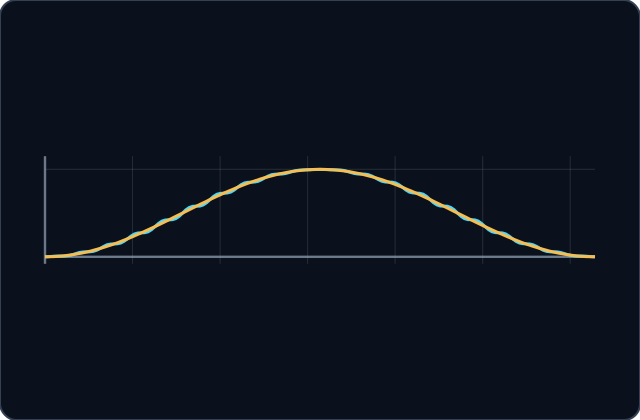
The upper level’s probability for an atom driven at with , against . The solid curve is computed exactly, with the drive’s fast part kept; the dashed one is the rotating-wave approximation, . The exact curve wiggles about the smooth one at twice the drive frequency, never more than 0.03 away.
The rotating frame
For , in the basis , set :
Properties
- , the detuning, is how far the drive is from the atom’s own frequency.
- The rotating-wave approximation drops terms turning at ; it holds when and are small against .
- The leftover fast terms shift the resonance slightly, by about (the Bloch–Siegert shift, stated).
The rotating-wave Hamiltonian
Substitute the turned state into Schrödinger’s equation: the frame’s turning subtracts , and conjugating by the turning gives . Multiplied by the drive’s cosine this is half of plus terms at , which are dropped.
Proof steps
Schrödinger’s equation for .
The frame’s own turning.
seen from the turning frame.
Products of cosines and sines at .
Drop the terms at , which average to nothing when .
Applications
Practice
Turning With the Drive
In a frame that turns about at the drive’s frequency, the atom’s own fast turning is reduced to the mismatch, and the drive looks almost steady.
Try it
Why go to a frame that turns with the drive?
The Same Populations
The change of frame only multiplies each amplitude by a phase, so the probabilities of and are the same in both frames.
Try it
The probability of the upper level is different in the rotating frame from the laboratory frame.
Detuning
The detuning is the drive’s frequency minus the atom’s own. In the rotating frame it plays the part of a bias.
Try it
An atom has MHz and is driven at MHz. What is , in kHz?
The Rotating-Wave Approximation
The drive seen from the turning frame is a steady half plus a part turning at twice the drive frequency. For a weak drive that fast part averages away and is dropped.
Try it
Which terms does the rotating-wave approximation drop?
Try it
The Bloch–Siegert shift is about . With MHz and GHz, what is it divided by , in kHz?
Try it
The rotating-wave approximation needs the drive to be weak compared with the atom’s own frequency.
Try it
An atom is driven on resonance with . How many periods of the fast wiggle, at , fit into one Rabi period ?
Final checkpoint
Try it
What does become when the drive is exactly at the atom’s frequency?
Try it
is exact for a drive .
Try it
In the rotating frame, which quantity plays the part of the bias of a two-level Hamiltonian?
Completion
Lesson complete
Great work! You now know how to:
- pass to the frame that turns with the drive
- derive the rotating-wave Hamiltonian and say when it holds
- read detuning as a bias and drive strength as a coupling